Showing posts with label Individualism. Show all posts

Thursday, January 17, 2008

Green consumers - they want to, but...

Interesting study from the marketing agency EcoAlign on consumer perceptions of clean technology (1,000 online survey respondents):

A new report on consumer perceptions of clean technologies in residential areas finds that 54 percent of the respondents surveyed have not adopted some form of cleantech largely because they don't understand it…

…Asked to rate cleantech products, most non-adopters considered the products expensive (53 percent), difficult to understand (72 percent), and difficult to maintain (76 percent). Cleantech adopters surveyed agreed with these assessments, though their negative scores were 10 percentage points lower. 60 percent of adopters also said they found the technology reliable, but only 44 percent considered the products beautiful.
The survey itself (the second one conducted by the company) makes for a good read (a quick sign-up is required to download).
The second EcoPinion Survey provides further evidence of a green gap between willingness to adopt or purchase green products, services and technologies, and consumer value perceptions around those offerings. While concern for the environment is at an all time high, consumers think that many forms of green technology (renewable, energy efficient or recycled materials) are cost prohibitive, difficult to understand and maintain, and aesthetically unappealing…

…This green gap in consumer perceptions offers insight into the dichotomy of customers’ stated intentions, e.g., their desire to be more green or frugal with energy consumption, and their actual behavior….The second EcoPinion survey results point to the clear need for companies to work harder to connect their products and services with the customer’s value chain around convenience, comfort, cost and design.
This has long been a point of concern among the environmental community, and those selling “green” products or services. While polls tend to show consumer interest in environmentally conscious and/or energy saving products is rising, specific action has been muted at best (albeit with some successes also, such as Prius sales topping the Ford Explorer).

Joel Makower has long hammered this point home, with a great post last week:
This just in: pretty much every consumer is concerned about the environment and is thinking conscientiously about what they buy — how it's made, under what conditions, and by whom….sound too good to be true? It is, of course. But you wouldn't know it from the marketing studies I've been seeing — and the breathless headlines that result.
Other great posts from Joel on the same topic are here and here.

As I wrote in a post a couple weeks ago:
Perhaps the single most important aspect of marketing is "authenticity". Be it tweens, 18-34 men, housewives or NASCAR fans - know your audience and be real to them. The same of course applies for companies trying to reach consumers interested in the environmental practices, perhaps some of the toughest critics around.
No post on marketing to green consumers would be complete without the requisite “next steps”. And while that sounds snarky, I think EcoAlign does a good job with theirs, offering simple, concrete steps that may be marketing 101, but tend to be forgotten by people who should know better:
1. Invest the necessary money in market research. Market research is the skeleton of any successful marketing effort, and creating memorable, measurable campaigns that are grounded in core business, and customer expectations around the company’s brand and the value created.

2. Go deeper and articulate more compellingly the reasons why people should care and act in regard to the green tech offering. Energy tech companies are dominated by an engineering-centric, product-oriented view of the world, yet customers are more attuned to emotional appeals. This approach must be achieved through careful messaging segmentation and utilizing the full range of delivery channels, including new media.

3. Align design with functionality.
While customers are satisfied that most green technologies are “reliable,” meaning that they will work as advertised, more attention needs to be paid to how these technologies look and feel to the customer. Sustainability can be beautiful, and command a premium for that value.

Wednesday, January 16, 2008

News and notes - Green jobs, nuclear, demand response. wind, green investment and more

CSR Jobs Rank High for Newly Minted MBAs: I'm a little dubious about the methodology (two job posting sites?), but this study demonstrates the growing demand and supply for CSR-related jobs (especially environmentally-related). A link to the study and presentation of its findings is here. Definitely some interesting information and resources at the tail end of the presentation.

Seen an uptick in nuclear power-related news recently. I'm still staying out of the debate, but wanted to pass on some articles I've found interesting. So here are two positive articles: "Devil’s Advocate: 10 Green Arguments for Nuclear Power", "A chance for nuclear industry to clean up its act", and one negative: "Green advisers dismiss nuclear plans as 'megafix' solution"

Powerit: Cashing In On Making the Grid Smarter: energy demand management system from a new venture that I imagine will soon be (if not already) embarking on its Series B round.

Making Fuel Consumption Visible: I love the broader concept underlying this announcement, and have posted on it several times. I hope someone is conducting a study looking at fuel consumption rates based on this technology, as I imagine the results would be striking.

Wind Power and M&A: A Moveable Feast: article detailing some of the consolidation now happening in the wind power industry. Ireland's Airtricity starting developing wind projects four years ago, and was recently acquired for $1.4 billion. Nice.

Unlike GM, Chrysler touting all-electric cars: As CNET points out, the #3 automaker in the US needs to differentiate itself from the top 2 (as in any mature industry really), and thus Chrysler is looking beyond hybrids and alternative fuels to all-electric vehicles.

How Green are Your Earnings? AltEnergyStocks looks at the question: should GE be included in a green portfolio or index?

Friday, January 11, 2008

Morning links - wind, PEVs, green business, transportation and smart-grids

Various items I've come across this morning that I thought I'd share.

Size Matters: Good round-up on wind development and investment in the U.S. from the WSJ's free blog "Energy Roundup". Several new developments are noted in this post, including the first-time use of 3MW turbines in the U.S., competitor collaboration among Enel and GE, and increasing industry consolidation.

Race to Make Electric Cars Stalled by Battery Problems: Long front-page story on the challenges plug-in hybrid and electric vehicle makers face in sourcing batteries that are safe and reliable. Very good overview, and adds some necessary context to my post yesterday on PEVs.

Wal-Mart faces hurdles in green electronics: Wal-Mart's sustainability push, and the sizable impact of that decision on manufacturers, other retailers, supply chains, and ultimately consumers, has been reported and debated ad naseum. This article discusses some of the challenges electronics manufacturers (and Wal-Mart) are facing in meeting Wal-Mart's objectives. Depending on the outcome of next year's elections, we may finally see some kind of federal legislation that consolidates the wide-ranging standards for energy efficiency, sustainability and recycling.

27 electric cars companies ready to take over the road (h/t Earth2Tech): An interesting list of electric car manufacturers. There are enough cars here for every taste and desire imaginable.

Moving Billions of People on a Still-Green Planet?: Rather fascinating piece from the NYT's blog on environment, focusing on broad trends and scenarios in transportation. A lot of links and research here to digest.

News Flash: 110% of Consumers Shop Green!: Joel Makower is one of my favorite thought-leaders in this space, and his new post on the environmental consumer and greenwashing has far-reaching implications. I covered a similar topic (sparked by an earlier Makower post) here.

What's so smart about smart metering?: Its a couple weeks old, but an informative interview with the CEO of smart-grid-focused company. I thought it wrapped up a lot of what I've been discussing recently here, here and here.

Thursday, January 10, 2008

GridWise Study: saving energy through smart grid management

A wonderful new study out of the Pacific Northwest National Laboratory on smart grid management demonstrates very effectively what this blog has discussed in detail here and here:

A yearlong study by the Department of Energy has concluded that when consumers are given the means to closely track and adjust their energy usage, power use declines by an average of 10 percent. In addition, the study found that households' electricity usage during peak times fell by up to 15 percent.
Additional reporting on this study provides more detail:
The demonstration project was as much a test of consumer behavior as it was of new technology. Scientists wanted to find out if the ability to monitor consumption constantly would cause people to save energy…

...112 homes were equipped with digital thermostats, and computer controllers were attached to water heaters and clothes dryers. These controls were connected to the Internet. The homeowners could go to a Web site to set their ideal home temperature and how many degrees they were willing to have that temperature move above or below the target. They also indicated their level of tolerance for fluctuating electricity prices...
The households, it turned out, soon became active participants in managing the load on the utility grid and their own bills.
As I wrote here in my predictions for 2008: "Some smart people will begin applying the lessons of the most recent technological revolution to the consumption of energy". Key to the success of this study was Internet-enabled technology such as two-way, real-time communication and online banking:
Participants received constantly updated pricing information via the Internet. The ability to connect the homes with energy providers as well as the grid was made possible through IBM technology known as a service oriented architecture (SOA). A "virtual" bank account was established for each household and money saved by adjusting home energy consumption in collaboration with needs of the grid was converted into real money kept by the homeowners. With the help of these tools, consumers easily and automatically changed how and when they used electricity, for their own financial benefit and the benefit of the grid.
Another study conducted in parallel looked at allowing appliances to automatically adjust their power use based on elevated or reduced demand stresses on the grid, thus serving as a “shock absorber” for the grid:
The Grid Friendly appliance project fitted 150 homes in Oregon and Washington with "smart" dryers and water heaters equipped with circuit boards to detect when the power grid is stressed. When that happens, the appliances curtail power use for a minute or two.

Grid friendly" circuit boards could be put in refrigerators, and other big appliances...If every big household appliance in the country were so fitted, the U.S. could cut electricity use by 20 percent.
The study further predicts that in five years, GridWise-type smart system for appliances will be available in 10 to 15 percent of U.S. homes. Currently the cost of installation is $500 and falling.

More information on the study is available directly at the PNNL GridWise website. A good recap of the study is here, while those with extra time on their hands can read through the two 150 page reports that accompany this study. They are dense reads, but the conclusions and additional readings sections are definitely worth a look.

Still, there are many challenges to overcome before this type of participatory strategy can be put into practice:
Many utilities are experimenting with this so-called smart-grid technology, but most are using it to upgrade their own networks, not to let households manage consumption. One big hurdle is that in most states, utilities are still granted rates of return that depend mainly on the power plants and equipment they own and operate instead of how much energy they save.
What’s also incredibly interesting in this study is that rather than focus on subsidies and mandates (yesterday's WSJ article on PG&E $117 million program to subsidize CFL purchases) this project relied on real-time market information and direct price signaling to encourage natural human behavior.

Further, this study adds to the growing body of evidence, such as this IBM report, this SmartPower study, and this So. Cal Edision experiment, that all demonstrate a key principle: The individual energy consumer will actively participate in their energy use with appropriate incentives, tools and information. The question then becomes, are we willing to make them a direct and engaged part of the solution?

UPDATE: couple of great additional readings from the PNNL report Part 1:

Energy efficiency: Super savers: Meters to manage the future
The Path to Perfect Power: Galvin Electricity Initiative

UPDATE II: this post is a definite must-read, offering several different perspectives as to the potential of the concepts outlined above:

Want to Manage Your Energy Usage? How Badly?

Wednesday, January 09, 2008

Other links from today - market transformation, cleantech investing, and global risk

A few other items of note today:

Utilities amp up push to slash energy use: Great article in the Journal today (subs. required) about the California "carrot/stick" approach to incentivize utilities to push energy efficiency, mandating a reduction of equivalent to three power plants...or else:

The state has designated $2 billion in utility customers' payments to be spent over three years on conservation programs. The utilities need to spend that money to find ways to avoid another $2.7 billion in energy costs, by reducing demand enough that they can buy less power or build fewer plants. If they come close enough to the target, regulators award them a cut of the savings; if not, they pay a penalty...
As one would expect, PG&E (California's biggest utility) is emphasizing the easiest and cheapest method to reduce energy consumption: compact fluorescent lightbulbs. So far the utility has spent $116 million on rebates and subsidies, which has helped contribute to CFLs selling for $0.25 to $0.50 (10 to 20 times less than in 1999). All told PG&E subsidized the sale of 7.6 million CFLs last year, and up to 20 million this year.

No doubt the outcome of this experiment in market transformation will be extensively studied. If it proves successful in generating long-term, sustainable energy reductions, while allowing CFLs to finally supplant incandescents, this is a good example for other market-based renewable efforts to follow.

F.T.C. Asks if Carbon-Offset Money Is Well Spent: following up on Monday's post about the FTC hearings on green marketing, the carbon-offset portion received a good deal of press. Some good examples of green business within the article.

Cleantech funding rising, may overvalue sector: I always enjoy the articles that rely exclusively on anecdotal evidence to prove a headline. I definitely believe certain sectors are over-valued, but I'm not ready to call it a "bubble" just yet.

WEF warns 2008 uncertainties may hurt climate fight: I mentioned this here, and its something I'm looking at closely. What happens to the momentum around climate change, renewable energy development, green business, if a particularly nasty recession hits? The report itself has a scary list of risks for 2008 focused on four areas: financial security, food security, supply chains and energy.


Plug-in Electric Vehicles

For whatever reason, I came across a number of developments today in the plug-in electric vehicle space. In that PEVs are another example of technology that empowers the individual energy user, (and I just posted on a similar theme), I thought I'd highlight them here. Apologies for the lack of structure or continuity in this post.

"Smart charging" plug-ins

Some estimates place the number of plug-in vehicles by 2015 at 500K to 1.5 million. Unfortunately, for utilities, if plug-in electric cars achieve anywhere near this level of penetration, the electricity usage could be enormous.

For example, in an ACEEE study last year, a typical electric-only car might have an efficiency of 4 miles per kWh. If you assume an average 1,000 miles per month driving (and possibly more with the anticipated reduction in fuel prices) one car could “consume” 250 kWh per month. According to the EIA, the average household used about 900 kWh back in 2001 (their most recent data). Thus, acknowledging the multiple caveats associated with back of the envelope calculations such as this, switching from a gasoline-powered car to a pure electric would increase household energy usage by over 25%.

Therefore, while the actual fuel savings (and accompanying emissions reductions) would be significant, plug-in electric cars would need large amounts to draw large amounts of electricity from already over-stretched utilities and infrastructure.

This is where companies such as V2Green come in. V2Green is an early-stage venture focused on developing both the hardware and software necessary for utilities to efficiently manage the rate, pace and timing for charging plug-in vehicle. Its technology would allow thousands of vehicles to wirelessly communicate with utilities in order to determine the optimal charge time. The company faces a number of challenges (need for outside capital, partnering with both utilities and vehicle manufacturers, small current market size), but believes it is poised as the leader in a new market opportunity. Today, it announced a transition to a new CEO who will focus on V2Green’s growing business responsibilities (a typical process for most new technology ventures).

Over the past few months, Earth2Tech has written a number of smart posts focused on the company, and the broader challenges and opportunities in managing the electricity needs of plug-in vehicles and the potential for this new technology. Recommended if you're interested in learning more, and also here (h/t Earth2Tech).

Rapid charging of plug-in electric vehicles

Along a similar vein comes this commentary from Leonardo Energy today.

When screening the data sheets of prototypes electric vehicles and electric vehicle batteries, you often come across some spectacular recharging speeds…What the data sheets don’t say is that the electric connection must be capable of supplying sufficient power for this rapid recharging....Consequently, rapid charging would be impossible at home. Moreover, it would create a serious challenge for any grid connections for electric recharging stations located along the road…

…That is why some experts, like Andrew Burke, an electric vehicle engineering pioneer at the University of California, see the rapid charging of plug-ins as a technological dead end. Others, like Alan Gotcher, CEO of Altair Nanotechnologies, see those barriers merely as challenges that need to be overcome. Watch this space to see which of these two visions prove right.

The articles and study within the post add context, and are an informative read if this is of interest.

Boosting batteries

Finally, I wanted to close on a couple of developments that involve the actual batteries with the vehicles. While this should be a much longer post, I am including these two links here to highlight the fact that many technological advances that could impact PEV's are coming from parallel industries. This article (from several months back) helps explain the value of the two potential advances below:

Nanowire battery can hold 10 times the charge of existing lithium-ion battery
Stanford researchers have found a way to use silicon nanowires to reinvent the rechargeable lithium-ion batteries that power laptops, iPods, video cameras, cell phones, and countless other devices.

The new technology, developed through research led by Yi Cui, assistant professor of materials science and engineering, produces 10 times the amount of electricity of existing lithium-ion, known as Li-ion, batteries.

Cui said that a patent application has been filed. He is considering formation of a company or an agreement with a battery manufacturer. Manufacturing the nanowire batteries would require "one or two different steps, but the process can certainly be scaled up," he added. "It's a well understood process."
A Better Battery for Laptops

Boston-Power says that it's poised to enter the market for portable power, with a notebook battery the company claims is safer, lasts longer, and can be charged faster. The Westborough, MA, startup recently announced that it is more than tripling production of its high-performance battery, called the Sonata, after receiving $45 million in a third round of venture financing. The move puts the company in a position to mass-produce and commercialize its next-generation lithium-ion battery within months…
While focused on laptop computer batteries, there are hybrid-electric vehicle applications as well:
The unmatched safety benefits available from Boston-Power's technology apply in …other applications such as hybrid electric vehicles (HEVs). With existing notebook computer batteries containing roughly the same power as hand grenades -- and HEV batteries representing far greater than that -- Boston-Power's proactive, preventative safety features overcome the issues challenging current Lithium-ion batteries.

Encouraging the Individual

One of the primary themes of this blog involves the meta-trend of individuals actively participating in their energy consumption, generation and management. I recently came across an interesting post outlining some potential consumer-based activities that could save energy and help the environment. While I applaud the intentions behind this post, I thought I might comment on a different strategy here, which is based on my personal perspective of explicitly engaging the individual.

Environmental Defense - Eight Earth-Friendly New Year’s Resolutions:

1. Replace my conventional light bulbs with energy-efficient ones.
2. Calculate my carbon footprint and see what I can do to reduce it.
3. Make small changes at home.
4. Drive like the Earth depends on it.
5. Buy carbon offsets to help offset my emissions even further.
6. Choose seafood that’s good for me and the ocean.
7. Write my members of Congress demanding a strong global warming law.
8. Pass this list on to my friends and family.
Certainly the first three – changing to CFLs, calculating carbon footprint and making other small changes at home – are immensely important and relatively easy to do.

Where I challenge are the remaining five. Each is very much a relevant and useful environmental action, but I’m not sure if this is the best audience for these activities, or if these are the best tactics for that audience. And as the goal is ultimately to inspire and elicit action, I thought this a relevant critique.

Telling people (especially Americans) to change how they drive has never been very successful, unless it occurs through regulations (speed limits) or some form of incentives (or disincentive) such as peak congestion charges, car pool lanes, taxing gasoline, etc. Buying carbon offsets seems to conflict with the entire premise of the piece (which is reducing energy consumption). I’m not sure where # 6 comes from, and the last two are innocuous but sadly futile.

Instead, were I to make this list, I would have focused on empowerment and incentives. The individual consumer can do a great deal to encourage "right behavior" by leveraging one thing they have control over: his/her purchasing power. So, for example, rewarding environmentally friendly companies with spending and penalizing those that are the opposite.

Also, I might also think about areas where the consumer could take control in their home. Give the consumer tools to monitor the actual energy usage of their applicances. Encourage them to sign up for smart-metering (if available) or green power, or have them lobby their city to use companies such as RecycleBank.

Along those lines, I thought this, ("Green Plug looks to cut energy waste and cable clutter") both a cool little innovation and a wonderful technology to promote. Lou Grinzo seems less enthralled, but even if this isn't the exact right type of technology, it is a good example related to the above.

Tuesday, January 08, 2008

News and notes - electric cars, solar, CCS, ethanol, marketing and more

Charged up by electric cars: Tyler Hamilton's interesting new column on electrification of cars covers what large automakers and small entrepreneurs are doing in this space, and also speculates on the accompanying importance of load management software. More here on his blog. (he's a one person media conglomerate)

SunPower’s solar power plant building boom: details on SunPower's multiple new solar installation deals in Europe (especially Spain). Given that Spanish PV sector grew 500% in the last year, perhaps this is not surprising.

Solar-energy sector seems primed to grow. Nothing new, but some good P/E numbers on some very highly valued solar stocks - First Solar is at 130 time earnings, SunPower 60x, while others are lower (e.g. Trina at 18x).

Archer Daniels Midland to Bury Carbon From Ethanol Plant: ADM is working with a number of state and national government agencies to inject 1 million tons of carbon underground. Project is expected to cost $84 million, with almost $67 million coming from the Department of Energy.

Canon Unveils "Generation Green" Brand: at first, I was writing a snarky little post about this, until I remembered that Canon ranked number one on the Climate Counts scorecard, put together by Clean Air. Perhaps it was the company's environmental bona fides, that explained why a rather plain announcement got quite a bit of media attention.

Open Source Free Energy Tech: given my interest in leveraging successes from the Information Age, I thought this a wonderful example of energy technology development using the open-source method.

Deeya Energy Raises $15 Million Series B Financing for Energy Storage: yesterday, I linked to a great interview with two DFJ VC's. Deeya is one of their cleantech investments.

Switchgrass shows promise for ethanol production study
: finally, some good news for pro-ethanol folks on the cellulosic ethanol front. Apparently, native North American prairie grass produces 540% more energy than energy consumed, compared to previous estimates 343% net. According to the article, this is due to higher yields from new breeds of switchgrass.

Thursday, January 03, 2008

Thoughts on 2008 - caution and optimism

Below is a collection of my own predictions for 2008 in cleantech and sustainable business, along with links to writing I've done in the past covering these topics. My post on the predictions from other bloggers, writers and experts is here.

1) Weak US and global economic conditions will have some negative impact on the “green movement” in the short term.

The weakening U.S. and global economies will dampen investor enthusiasm in all things green and cause national politicians to temporarily back off their environmental pledges. The frigid housing market will negatively impact PV solar installation in the US and the poor economic environment will cause some cleantech companies to fail or post poor results. These won’t be representative indicators, but the mainstream media, in a downcast mood, will jump on these outcomes anyway as signs the “green” boom is ending.

Due to this, many undecided Americans will take a step back to pause and reflect on the “green movement” (a term I dislike, but use to encompass “clean energy investment”, “corporate sustainability”, “climate change solutions”, etc). I think there are still many more skeptics than optimists regarding the potential future success of renewable energy and green business. These developments will give the skeptics ammunition to re-emerge and question if the hype is justified. While I think this backlash would have occurred naturally, the 2008 conditions described above will exacerbate it.

2) However existing concerns (energy prices, climate change etc.) will remain, lessening the impact of the developments described above, and allowing for the future long-term development of the “green movement”.

The pause in interest in all things green will be short-term. No more than a year. High energy prices, energy security concerns, increasing scientific certainty around anthropogenic climate change and new weather phenomena (climate change-induced or not) will mitigate some of the media (and the public’s) skepticism and ensure continued interest in all things green. Climate change will not be a large campaign issue (too much issue clutter), but it will be discussed, especially if McCain gets the Republican nomination.

Longer-term, the steps taken to boost the economy (lower interest rates, tax cuts/credits, housing industry bailout) will have a beneficial longer-term impact on the “green movement” spurring consumer and business interest and institutional investment. U.S. politicians and business leaders will recognize the value (and currently wasted opportunity) in developing the variety of industries under the “green/clean” banner. But that will be a 2009-2010 development.

3) One new trend will capture public imagination, while solar will experience a backlash.

This stems from a conversation I had a few months back. To borrow from my own writing, it certainly seems as though the last few years, one specific technology has captured the imagination of the media, the business community and the public. There’s a love affair for about a year, followed by the inevitable falling out of love period, as various individuals question the economic, environmental and political realities underlying each technology. 2004 was the year of the hybrid (Prius); 2005 - wind; 2006 - biofuels; 2007 - solar. I see no reason why this pattern won't repeat itself. As to what 2008 would be, I think I'll stick with energy efficiency (although I'd broaden it to include #5 and #7 below).

4) Coal power plant cancellations will grow, sparking interest in a variety of energy alternatives

As I blogged here, I believe the pace of coal plant cancellations or postponements will quicken. I last counted 22 cancellations in the past 12 months. There’s a reason why a lead Citigroup analyst (and others) downgraded coal stocks in July. There are a number of financial ramifications as a result of this, but more importantly, that lost capacity must be made up somewhere. Utilities and power generators (and city and state governments) will need to choose between natural gas, lobbying for nuclear, or looking at other alternative technologies.

5) Some smart people will begin applying the lessons of the most recent technological revolution to the consumption of energy.

As I also blogged here, the concept of empowering and engaging the consumer, so that they are actively involved in the generation and consumption of their own power will be a dynamic trend in the coming year. Demand response technology, smart and net metering, last-mile smart grid efforts, incentivizing energy efficiency – each can and will play a role. Although as my caveat above stated, we should only be witnessing the start of this long-term trend, and maybe even just the first outliers.

6) Reducing the energy intensity of transportation will be the primary focus, but the solution is still to be determined.

Whether one considers the new Energy Act, the build-out of high speed trains, the focus on ethanol and infrastructure from “field to fuel pump”, or electric vehicles and battery storage, the bottom line is this. We need to get people from point A to point B using less energy, and with less environmental damage. I didn’t post as much on this topic as I would've liked this year, but it is one that will continue to hold the attention of investors, policy makers, corporate executives and individual consumers. 2008 will see a variety of solutions proposed, and while I don’t see one gaining more favor than any others, I do believe those solutions that keep #5 in mind may do well.

7) “Design” and aesthetic appeal will be a growing consideration and differentiator among renewable energy and other clean technologies.

My significant other has long appreciated the idea and concepts underlying renewable energy, but disliked the outwardly unappealing and awkward appearance of solar panels, wind turbines, CFLs, etc. I think it’s a valid criticism. Key to the resurgence of a number of companies (Apple, Mini Cooper) and has been the focus and integrating of style and design with technology. Everything from green buildings to urban environments to distributed generation could benefit from a similar philosophy and I think they will in 2008.

8) Labor shortages will be as big a constraint to the energy industry (traditional and alternative) as polysilicon and turbines are to solar and wind respectively.

Clean Break (linked above) has a good reference on this (although he has a different take), and I’ve posted about jobs in the green industry here and here. The US was already suffering from a dearth of engineers and scientists in most fields, but the shortage appears especially acute in energy. The lack of qualified technicians and installers for distributed generation mirrors a similar shortage (for different positions) in traditional oil, gas and power. While some “green jobs” legislation was included in the Energy Act, ultimately, much more support is necessary to meet the growing need for labor in this space.

9) People will focus on “managing intermittency” through diversification and other energy portfolio strategies, as well as a variety of energy storage solutions.

I’ve covered the geographic diversification and intermittency issue here for solar and wind in detail. Outside of cost per watt, this is the biggest challenge and drawback for renewable energy. It’s not a bold prediction to state the people will be working on ways to store energy where intermittency is a factor, but I do think more project financers, investors, energy executives and policy makers will focus on the potential value in diversification across regions for wind and blending solar (Thermal, CSP and PV) with other renewable and traditional energies.

****

So that’s it – my predictions for 2008. Before writing this post, I didn't expect that I would leave out predictions on carbon legislation and carbon markets, emission measurement technologies and global climate change policy. I could be wrong, but ultimately, given the economic challenges and US elections in 2008, I don’t think much will be happening in those areas.

I was somewhat surprised also by my pessimism, but as I worked through this post, I started to realize what had been bothering me about so many of the predictions and forecasts I had read. Many (especially the optimists) seemed to be looking to cram at least 5 years of development and success into 2008.

I personally believe the industries that are growing around cleantech, renewable energy and green business are strong enough to withstand a pause, and in fact could benefit from one. That’s not to say that I wouldn’t love to see growth that far exceeds the $117 billion invested this year and in fact I’m sure just that in 2008. But the rush to invest and overwhelming interest in all things clean and green is, yes, beginning to look a little frenzy-ish and bubble-ish. And I’d rather smooth that out of the system now, than go through a dot-com cycle lasting five years.

Friday, December 28, 2007

PV solar data in 2006 and 2007 - (less than meets the eye?)

According to some reports, there has been some impressive 2006 and 2007 growth in the PV solar space. The actual report is here. Diving into the numbers however leads me to some more conservative conclusions.

  • Annual PV production increased to 3,800 megawatts globally in 2007, up an estimated 50 percent over 2006. Cumulative global production is now at 12,400 MW. Since 2002, production growth has increased 48 percent each year.
The usual caveat is that the production capacity base has been so low for so long, that 12.4 GW (non-peak) is an infinitesimally small amount of energy capacity globally. While these are good numbers that the media and investor community can publicize, I’m more interested in installation than production. Unfortunately, annual installation numbers aren’t as impressive, except in the US.
  • According to the 2007 estimates, annual worldwide installation increased to 2,287 megawatts, up 31% from 2006 when 1,740 megawatts installed.
Breaking down the numbers on a region-specific basis adds some additional color:
  • In 2006, Germany added 1,050 megawatts, and another 1,260 megawatts in 2007 (estimate). There are now more than 300,000 buildings with PV systems in Germany.
  • Japan, the United States, and Spain round out the top four markets with 350, 141, and 70 megawatts installed in 2006, respectively. Japan’s growth slowed considerably, while Spain tripled its PV installations in 2006.
  • The growth in U.S. installations increased from 20% in 2005 to 31% in 2006, primarily driven by California and New Jersey. Initial estimates for the United States as a whole indicate that PV incentives helped to achieve an incredible 83% growth in installations in 2007.
In that Germany has accounted for at least half of all global installation since 2003, its phenomenal growth has pushed overall global growth rates higher. Removing Germany from worldwide numbers reduces previous annual growth rates in PV installation from 2003-2006, but increases this year’s growth to 48%.


[Click picture for larger image]


While these are positive numbers, I always keep in mind that consumer adoption rates have been much higher for other technologies. While perhaps a bit apples to oranges, consider the following:


Several years of 40%-50% annual growth are very positive, but given that PV solar is on less than 1% of all American roofs, there will need to be many more years of 75% growth (and higher) to reach 10% and 50% adoption.

The top five PV-producing countries are also interesting.
  • Ranked in order, they are Japan, China, Germany, Taiwan, and the United States, with China expected to be number one by 2008. China almost tripled its PV production in 2006, and is estimated to have doubled it again in 2007.
Finally, unfortunately costs still don't appear to be coming down. While everyone is aware of the impact of the polysilicon shortage, looking at the past few years isn’t especially heartening. Although spun in this report as an overall decline, and 2007 numbers aren’t included, one can see the impact of supply constraints and strong demand.


Overall, the first set of numbers looking at the 2007 solar industry are positive. While these are good numbers (and if you’re a PV solar advocate, credit to the Earth Policy Institute for spinning them so strongly), 2007 and 2008 actual results may need to be much higher to justify the positive press and investor interest.

Thursday, December 27, 2007

Individual Empowerment and the Consumption of Energy

This is a longish lead-in to the first post (of many) on how consumers are growing increasingly empowered in their ability to directly manage their individual energy usage and consumption. As always, I welcome any thoughts/feedback in the comments section.


The tremendous advances of the telecommunications, computing and Internet industries have wrought far-reaching economic, political, societal and behavioral changes, many of which we’re only just beginning to see. To list all of them would take a lifetime and is far beyond the scope and expertise of this blog.

However, there is one development which I believe directly relevant to what I discuss here daily. I’ve long been fascinated by how in many industries (e.g media, retail, communications, entertainment) “the Individual” has been empowered at the expense of the larger corporate entity, but to the benefit of the industry. One recent example I came across yesterday:

People once believed that the Net was going to transform where we shopped—that it was going to make physical stores obsolete. It hasn’t…What it has changed is how we shop…

…The results of this shift are obvious. First, consumers know a lot more about prices than they once did... It’s harder to create a sense of urgency around short-term sales…And the wealth of online product reviews and commentary has made the cues that stores use to shape shoppers’ perception of quality and value far less effective.

This doesn’t mean that consumers are impervious to retailers’ tricks…Still, there’s no disguising the fact that power has shifted from sellers to shoppers.
For other examples, think TiVo, NetFlix, open-source software, blog aggregators, eBay, Wikipedia, etc. Each allows its users to enhance and reshape their consumption experience while increasing the utility and efficacy of the products/services in question. More importantly, consumers, especially younger generations now anticipate and expect this capability to become available in a much broader swath of industries.

I know I’m generalizing excessively, but moving forward, I will be extending this concept of “individual empowerment” to energy generation, distribution and consumption as a key theme of this blog. Ultimately, this idea of individual empowerment is where I believe many of the most important opportunities in renewable energy lie.

To this end, I'm extremely interested in the policy, research and business models that reshape the Individual’s experience with energy – giving people demand-response technology so they can monitor their consumption, providing affordable and effective distributed technologies so they can generate their own power and sell the rest back to the grid via net-metering, powering their hybrid vehicle directly from this distributed generation rather than going to the gas station and recycling their garbage and waste for both power and profit.

Ultimately, the Individual is empowered, actively engaged in their own power consumption and generation, to their profit and the profit of the industry (and society and our environment) as a whole.

Research is beginning to bear this out. Consider this recent report from IBM:
Historically, the relationship between utilities and consumers has been rather lopsided – utilities had the power, both literally and figuratively. But the confluence of climate change concerns, rising energy costs and technology advances leading to greater consumer involvement is now radically redefining that relationship. Our recent surveys of 1,900 energy consumers and nearly 100 industry executives across the globe reveal major changes underway – a more heterogeneous consumer base, evolving industry models and a stark departure from a decades-old value chain. We believe companies need to prepare now for a participatory network that enables customers to choose from a wide variety of suppliers, actively manage their consumption and even sell back surplus power they generate. ..

….We anticipate a steady progression toward a Participatory Network, a technology ecosystem comprising a wide variety of intelligent network-connected devices, distributed generation and consumer energy management tools….

…Within five years…we believe sufficient supplier choice will allow meaningful consumer switching to emerge in most major competitive markets. Also…we expect utility demand management initiatives to expand dramatically and electric power generation by consumers to make tremendous inroads within ten years.
If you buy the concepts underlying this post, then this report is a must read. The accompanying survey is also insightful, although it makes me feel as though I’m putting a little too much faith in the typical energy consumer.

Other surveys point to similar findings. In one recent poll of 1,004 U.S. adults:
49 percent said they plan to make an eco-friendly New Year's resolution. Out of those making green pledges, 75 percent said they would most likely reduce energy use in their homes, 74 percent plan to recycle more, and 66 percent will cut their use of harmful chemicals.
A recent study by SmartPower on how best to motivate consumers to conserve energy draws some very similar conclusions:
Like any typical consumer, the participants in SmartPower’s study want to know what is in it for them. They yearn to be inspired. They do not want to be preached to. They want to feel that they are a part of a “we” approach. They want to understand and feel the real-world ramifications of their actions. They’re busy. They’re over worked. They want quick, simple tasks they can do that will make a difference. They want to feel smart and cool. They want to feel empowered and knowledgeable about saving money and saving energy.
The actual study, although qualitative, is an interesting read.

Moreover, building on this study’s conclusions, there are a number of interesting products and services that I’ve come across recently that directly tie-in to both the study and the concepts underlying this post.

While it’s older than the rest, I was fascinated by an article in this past July’s WIRED Magazine, discussing a very simple way to engage consumers in reducing their energy consumption:
Mark Martinez couldn't get Southern California Edison customers to conserve energy…Then he saw an Ambient Orb. It's a groovy little ball that changes color in sync with incoming data…Martinez realized he could use Orbs to signal changes in electrical rates, programming them to glow green when the grid was underused — and, thus, electricity cheaper — and red during peak hours when customers were paying more for power. He bought 120 of them, handed them out to customers, and sat back to see what would happen. Within weeks, Orb users reduced their peak-period energy use by 40 percent.
The article goes on to cover a number of technologies and ideas that could make energy usage “visible”. Nathanael Greene goes into greater depth on one of them - the Wattson.

I’ve also come across a number of other technologies and ventures pursuing the same objectives (of course, the ones listed here represent a tiny portion of what must be thousands of opportunities):
  • Get a Kit, Cut Your Home’s Carbon Footprint. “Earth Aid Enterprises…is offering…customizable Earth Aid Kits come with a variety of products to help you reduce the carbon footprint of your house, apartment or dorm room: appliance timers, oxygenating showerheads, compact fluorescent lightbulbs, LED nightlights that turn on and off automatically, faucet aerators, programmable thermostats, Smart Power strips and more.”
  • Hooking up a greenhouse gas meter. [previously written about here] “[IBM] has collaborated with Evergreen Energy to create what they call the GreenCert greenhouse gas meter…an Internet-based software program designed to collect real-time emissions data from sensors and other sources. It calculates the volume of greenhouse gases being released into the atmosphere by a company and certifies any reductions as credits that can be traded on carbon markets."
  • Kill A WATT – Watts Killing You? "Connect your appliances into the Kill A Watt™, and assess how efficient they are. A large LCD display counts consumption by the Kilowatt-hour just like utility companies. You can figure out your electrical expenses by the hour, day, week, month, even an entire year."

Ultimately, this idea of "empowering" the individual, so that they are cognizant of the impact of their energy usage and the value that they can create, is where I believe many of the most important opportunities in renewable energy and environmental sustainability lie. As I stated above, I plan on making these topics, and the many issues that surround them, a key focus of this blog moving forward.

UPDATE: It's a couple months old, but this is another great example: Gadgets to Spur Energy Conservation, about glowing lamps that manage and inform on energy consumption and conservation.

Wednesday, December 12, 2007

Environmental markets, measuring emissions, algae and energy legislation

Environmental Exchange Is Planned. CCX has a new US competitor.

New York Mercantile Exchange parent Nymex Holdings Inc. and a group of Wall Street trading houses plan to launch an exchange for trading carbon emissions and other environmental products. Dubbed the Green Exchange, it will offer environmental futures, options and swaps contracts, Nymex will own 25% of the new Green Exchange venture, and its chairman, Richard Schaeffer, will be CEO until a new one is named. Morgan Stanley, J.P. Morgan Chase & Co. and Credit Suisse Group will be among the partners….Evolution Markets has been the designer of the new exchange.

Accurately measuring emissions: Interesting dichotomy presented in these two posts. Oxford Economist Dieter Helm and others have released a new study stating that the UK is significantly underreporting its annual GHG emissions:
…Official figures fail to capture the true picture because they don’t take into account pollution from aviation, shipping, overseas trade and tourism or the carbon footprint of Britons abroad. According to figures filed with the UN, Britain’s emissions are down 15 per cent compared with 1990. But the report says that the figure is actually up by 19 per cent once the missing emissions from shipping and citizens abroad are included.
Meanwhile one new venture is trying to take advantage of these measurement challenges (on the micro-level) via a partnership using IBM technology, to launch “Green Cert” which promises to ease the monitoring and reporting of carbon emissions. Additional information here. The concept of “empowering the individual”, and making them responsible for their energy usage and emission reductions, is especially interesting to me. I’ll post on this concept at a later date.

Once carbon has a non-volatile, transparent price, I imagine measurement accuracy will be less of a concern. Back in 2005, Trucost put emission levels at about 1,100 tons per million pounds sterling of revenue for FTSE 100 companies. So, for example, a company with $10 billion of revenue (almost all of the Fortune 500) would emit somewhere on the order of 5 million tons. If carbon goes at $40 per ton, and you miss your emissions quotient by 10%, you just cost your company $22 million. That’ll get your bosses notice.

That said, having spent time researching the difficulties in quantifying GHG emissions from tropical deforestation, I certainly recognize the immense challenges of cheaply and efficiently quantifying emissions. It won’t be easy. Expect many the launch of many more companies with new technologies and processes seeking to solve the measurement issue.


Algae to Biodiesel: This concept keeps popping up. I heard Martin Tobias (Imperium Renewables) speak at a conference last year and was intrigued by the idea. GreenFuels is another company in this space that’s drawn interest, but has had some recent problems.


New York taxis boosting fuel economy . Older news, but still interesting. New York City taxicabs purchased after Oct. 1, 2008, will be required to get at least 25 miles per gallon, and those purchased after fall 2009 will have to get 30 mpg. Turnover for NYC taxis averages 3-5 years, as this article from July points out, so expect most taxis to be changed over by 2012.


Senate takes up the energy legislation. Apparently the Senate may begin work on the new energy legislation. The 15% RPS has been dropped, but much of the renewable energy tax incentive package is still on the table (although dropping from $21 billion to $13 billion). This interesting post on Daily Kos states that most of the package focuses on solar subsidies, with extension of various renewable energy tax credits and sizable tax credits for hybrids. According to the post, the bill is exactly one senator away from passage. It’s a Kos diarist though so take with a grain of salt.

Friday, December 07, 2007

Consumer polls on climate change and the environment

It is always dangerous to extrapolate consumer behavior from polls. Questions can be leading or mis-leading, consumer decision-making isn't always rational, etc. Still, one of my goals for this site it to collect the plethora of surveys on the environment that I come across and post them here, both for future reference and to see how predicted trends actually play out.

I began at Two Steps Forward, where Joel Makower collected about 15 of these surveys several months (an Earth Day exercise). In going through these polls to try and catalogue the answers, I learned a few things.


(sorry about the picture quality. posting excel tables to blogger is an intelligence test that I just failed miserably. click on it and you can actually see it.)

1) Every polling outfit is asking different questions about the environment and accordingly receiving different answers. Given that most polls on these topics are driven (and paid for) by special interest groups, it makes sense that only the most carefully selected and tailored answers will be made public. The polls driven by the media (USA Today Gallup, ABC News, etc.) may be better, but I suspect that the interests underlying, say, the Fox News survey and the BBC News poll may diverge.

2) Survey respondents are a basket of different groups, again dependent upon the special interest group doing the asking. Some surveys are global, others focus on "consumers", others "the American worker", etc. This only adds to the challenge of analyzing results and seeing trends.

3) The results have some spread, but general trends are discernible. People seem to care about the environment, believe global warming is at least a reality and appear willing to take some (qualified) action to alleviate the problem. However, until the number of people who "believe global warming is caused mostly by humans" rises above 60%, I don't imagine there'll be much urgency in the matter.

To this end, the latest survey comes from the BBC under the caption: "Most would pay higher bills to help climate".

The survey found 83 percent of those questioned believed lifestyle changes would be necessary to cut emissions of climate warming carbon gases. The survey, conducted by two polling organisations for the BBC World Service, covered 22,000 people in 21 countries. In 14 of the 21 countries from Canada to Australia, 61 percent overall said it would be necessary to increase energy costs to encourage conservation and reduce carbon emissions.
Sounds great in theory. The only reference to the US and China was:
The survey said the findings applied equally in China, which is building a coal-fired power station a week to feed its booming economy, and in the United States, which is the world's biggest carbon polluter.
Color me unconvinced. Would love to see a little more data, but I don't think it's going to be forthcoming.

In any event, as I get my hands on more surveys, I'll keep them coming. Conversely, feel free to send me any you come across.

Wednesday, December 05, 2007

Turbine-less wind power

Cool innovation. Winner of a 2007 Popular Mechanics Breakthrough Award.

[Shawn] Frayne’s device, which he calls a Windbelt, is a taut membrane fitted with a pair of magnets that oscillate between metal coils. Prototypes have generated 40 milliwatts in 10-mph slivers of wind, making his device 10 to 30 times as efficient as the best microturbines. Frayne envisions the Windbelt costing a few dollars and replacing kerosene lamps in Haitian homes.
Lots of developing world applications. Especially appreciate the ease of repair and maintenance. (as a director of a clean drinking water non-profit once told me: "it's not finding the technology that's a problem, it's fixing it. How do you fix something in the middle of the African bush with no tools, no electricity and no city within two hundred miles?")

More information is available directly on the Popular Mechanics link.

Thursday, November 29, 2007

Taking the green out of Christmas

The Journal was feeling eco-frisky today. The title says it all: "All I Want for Christmas Is a Compost Bin".

Are soy candles and spinning composters on your holiday list this year? A bevy of so-called green retailers are hoping so. With so much public attention on climate change and sky-high oil prices, these retailers are pitching energy-saving or recycled items that haven't traditionally been on most people's wish lists -- a low-energy desk lamp, for example. And while many retailers have boasted luxury wrapping in past years, companies are this year proffering natural and biodegradable packaging -- or none at all.
Once you get passed the attention-getting (and cringe-inducing) headline and lead, it's actually an insightful article.

There's a disconnect in my mind in using a season of decadence and consumption (which I freely and unabashedly revel in) and the concept of "going green". Austere living and eco-consciousness does seem a bit out of place.

And in one of the ongoing themes I continue to focus on at this blog, there's a great deal of confusion among consumers, which marketers are eagerly capitalizing on:
The word "green" is being used in marketing very broadly -- to define a water filter for example, because it cuts purchases of individual bottles of water. So some consumers may wonder which products make a real difference for the environment. The word "natural" can also fluster consumers. Textiles made from 100% natural cotton often mean that no dyes or chemicals were added to the cotton, but it doesn't guarantee the cotton was grown without the use of pesticides or other chemicals.

"Green still kind of means a bunch of things," says Adrien-Alice Hansel, a literary manager at a theater in Louisville, Ky., who is looking for eco-friendly gifts this year. "It can mean less energy than an alternative, but more energy than something else." Indeed, not buying an item can be the best bet for consuming less energy.

Saturday, November 24, 2007

GBN - Impact of Climate Change Report

While this report - "Impacts of Climate Change" out of the Global Business Network is even older than the last post, it's rather fascinating:

This paper offers policymakers an alternative approach to thinking about climate change and its impacts. Instead of starting with climate change and working out toward impacts, we focus on systems that are already generally vulnerable first, and then consider what the geophysics of climate change may do to them.
The report focuses on the dynamic and chaotic nature of systems already vulnerable to instability. Areas covered include ecosystems, water availability and urban systems, as well as the role of the State in society, traditional political coalitions, and something I love: "The Global Pop-Politics of Rumors":
A key uncertainty for the political economy of climate change is how the public, which will all but inevitably remain scientifically unenlightened on the subject, will react to the news of climate change. One possibility, which has been largely realized in the U.S., is an ongoing, mutually reinforcing mixture of apathy and ignorance. Another possibility, however, is paranoid overreactions of various sorts.
I wonder what historical precedents gave them that idea...

Wednesday, January 10, 2007

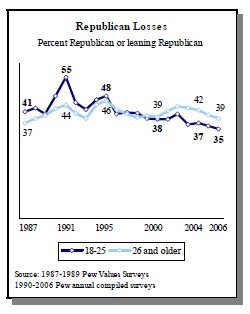
Recent Pew Survey on Gen Next

Really interesting stuff out of Pew regarding "Generation Next" - the 18-25 generation. Highly recommended, as reaching this generation (from a political, social and entertainment point of view) could be highly different than other generations.

First, note the difference between this generation's outlook on "friends" and entertainers vs. politicians and spiritual


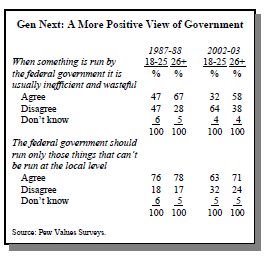
It's ironic, when you consider that this generation actually has a much greater appreciation for government than one's past:


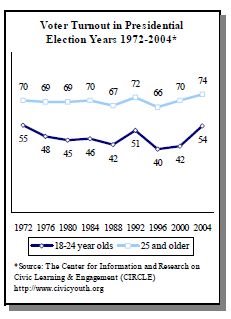
One of my favorite stats - look at the difference in turnout in 2004. That's a 25% jump from 2000. Also, note the similarity between 1972 and 2004 - apparently the Vietnam and Iraq wars are becoming more and more the same animal. (I consider 1992 an outlier, as it involved both Ross Perot, an interesting indie candidate, and Clinton, the first candidate to use MTV as a platform).


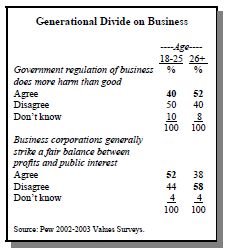
They also seem to hold what at first appear conflicting views on business and government regulation, but in fact aren't...rather that both are important in a healthy and functioning society and economy.


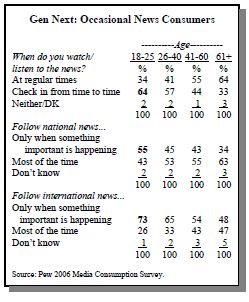
I actually disagree with Pew's interpretation that they consume news equally as with other generations. I view it as there are more passionate, motivated younger individuals and less people who aren't all that bothered to pay attention.


Couple other things I found fascinating - check out how they connect with environmental issues, and how unconcerned they are with race-based issues:


Finally, my favorite stat. Look at how much the younger generation (18-25) has changed from 1991 to present, while the age range 26+ has basically stayed the same. In 10-15 years, this could be seismic.

Monday, January 08, 2007

Japanese Energy Efficiency

Really like this story on Japan's extremely energy conscious ways.

Japan is the most energy-efficient developed country on earth, according to most specialists, who say it is much better prepared than the United States to prosper in an era of higher global energy prices. And if there is any lesson that Japan can offer to Americans, they say, it is that there is no one fix-all solution to living with oil above $50 a barrel.

Rather, as Mr. Kimura shows, it is a combination of many things, from the most advanced technologies to the simplest frugality in everyday life — and an obsession with saving energy that keeps his family huddled in a single heated room during winter.
The notion that it takes both the individual and a collective social consciousness working together is very valuable. The article also mentions the Japanese government's tax on gasoline which pushes it to $5.40 a gallon, and where the subsequent tax revenues have gone.

Finally:
Higher energy prices have also created strong domestic demand in Japan for more conventional and new energy-saving products of all sorts. That has spurred the invention and development of things like low-energy washing machines and televisions and high-mileage cars and hybrid vehicles, experts say. Japanese factories also learned how to cut energy use and become among the most efficient in the world.

Companies like Mitsubishi Heavy Industries are now reaping the benefits in booming overseas sales of their highly efficient electric turbines, steel blast furnaces and other industrial machinery, particularly in the United States. The environment ministry forecasts that exports will help turn energy conservation into a $7.9 billion industry in Japan by 2020, about 10 times its size in 2000.
Is it any wonder that Toyota and Honda have taken the lead in developing hybrid technology?

Friday, November 10, 2006

I remember you

Been a while, eh? Anything happened? Nah, I didn't think so...

That said...sigh...three months can go by so quickly. Anyways, I've got a backlog of things to post, although half of the links have probably been moved.

In any event, I wanted to draw attention to the recent NY Review of Books article, covering several recent books discussing global warming.

The books covered:
1. The Revenge of Gaia: Earth's Climate in Crisis and the Fate of Humanity (James Lovelock)
2. China Shifts Gears: Automakers, Oil, Pollution, and Development (Kelly Sims Gallagher)
3. Solar Revolution: The Economic Transformation of the Global Energy Industry (Travis Bradford)
4. WorldChanging:A User's Guide for the 21st Century (Alex Steffen)
5. Design Like You Give a Damn: Architectural Responses to Humanitarian Crises (edited by Architecture for Humanity)

Among the most interesting points to me:
1. Lovelock's tipping point relies on the same mechanisms as most other climate scientists, but as with most, his prediction of the results varies in both impact and time. Shorter Mr. Lovelock: we're screwed.
2. The Gaia hypothesis is alive and well
3. The science of climate behind climate change is moving faster than any literature can keep up. Apparently already An Inconvenient Truth is outdated.
4. Lovelock doesn't want wind power because it disturbs his beloved countryside.
5. Travis Bradford is an I-banker who believes solar will grow annually 20% to 30% for decades (similar growth rate in the computer chip industry). He discusses at length the success of Japan and Germany in increasing solar investment through government subsidies that are now no longer necessary.
6. "In retrospect, historians are likely to conclude that the biggest environmental failure of the Bush administration was not that it did nothing to reduce the use of fossil fuels in America, but that it did nothing to help or pressure China to transform its own economy at a time when such intervention might have been decisive."
7. Check out World Changing's website. Incredible resource for impacting our environment with simple technology at hand. Tremendous example of "the Wisdom of the Masses".
8. Where the hell is that carbon tax already?

Thursday, June 29, 2006

10 Technologies to Save Us

Expect to see a lot more of these...Popular Science has an interesting special section geared around various alternative energy technologies. The piece details how many different options we can explore:

1.) Wind - the price of wind energy has dropped 85% in the past twenty years. Imagine if this administration actually tried to help out.

2.) Enhance the energy grid's efficiency (ie, move smaller power generation closer to a source)

3.) Hybrid cars - if all American cars were switched to plug-in Hybrids, oil consumption would drop 70-90% overnight

4.) Ethanol - only this country could look to a process (corn) that makes things worse. Sugar, cellulosic, that's where we need to go

5.) Solar - two things need to happen - improve energy efficiency (currently only 15-30%) and make it portable (no, not watches)

6.) Hydrogen power - already twice as efficient as gas combustion engines

7.) Ocean - this was awesome. Portugal will soon start powering 15,000 homes; tidal currents are 10 to 40 times as energy dense as wind

8.) Geothermal - tap the earth's internal heat...although knowing us, we'll find a way to turn it off

9.) Biomass (waste) - 1500 cows can produce 1.8 million KW of energy

10.) Negawatts - turn out the lights when you leave the room dammit!!!