Friday, November 30, 2007

More on the cleantech data

A follow-up article on the boom in cleantech investing, as covered in my previous post. The title in this story is a little more oblique..."Green Energy Makes Money". Well, ok then.

Of interest to me, on several levels. How does the WSJ quote Mark Heesen, President of the National Venture Capital Association in their fashion, but somehow the same guy gives a complete different quote to Fortune:

"Long term, this is an area that is going to be as important to the venture capital community as biotech and IT have been in the last twenty years," says Mark Heesen, NVCA president.
I actually cut from the quote in the previous post. Here is the quote from the other article in its entirety.
“As has been demonstrated in the information technology and life science arenas, investing in new technologies can be fraught with pitfalls and is not for the inexperienced or the faint of heart,” he said. “Prudent, long-term, knowledge-based investment in cutting edge technologies has been the hallmark of venture capital in the past and should be the mantra in the CleanTech space as well. Short-term ‘tourists’ should steer clear.”
Both quotes make highly relevant points. Both quotes also could lead to very different conclusions. One is soundbite snappy, the other far more nuanced. Interestingly, the former is a mainstream online publication, the latter a blog.

On a separate note, among the causes (per this article) of the sizable increase in cleantech investing:
The emergence of the Indian and Chinese economies, both of which are consuming energy at a rapidly increasing rate, has drastically expanded the potential market for new energy technologies. Meanwhile, the combination of rising oil prices and environmental concerns has strengthened demand from policy makers and the public for alternative and more efficient sources of energy.

Thursday, November 29, 2007

Cleantech bubble? Part 1

Cleantech VC investing continues to set records:

Clean-tech investments by U.S. venture-capital firms set a record of $2.6 billion from 168 deals in the first three quarters of 2007, according to data from Thomson Financial and the National Venture Capital Association. The level of investment represents the highest dollar volume ever, surpassing the figure of $1.8 billion for 180 deals for the full year of 2006.
Is this good news? It’s a theme I plan on returning to a great deal, but I wanted to begin discussions here. One argument is represented by the next statement from the post above:
Mark Heesen, of the National Venture Capital Association, said venture investors should exercise caution. “As has been demonstrated in the information technology and life science arenas, investing in new technologies can be fraught with pitfalls and is not for the inexperienced or the faint of heart.”
I’ve been following this meme for a while – the belief by the mainstream business media, and many VCs, that we’re in the midst of cleantech bubble. Yesterday, I sat in on a speaker who was obsessed with a bubble in this space, despite the fact that his tiny fund had no cleantech investments, and he couldn’t seem to separate over-valuation of solar companies, from the rest of the cleantech space. (in spite of what some may believe “cleantech” isn’t just solar)

As I listened, I began to wonder something: did the bursting of the 1999-2002 dot-com bubble so negatively impact the psychology of the typical VC investor (and the media that covers them), that they now see bubbles where they may be none?

After all, the 4 year dot-com excess was a unique historical event (in terms of capital raised, funds launched, investments made, and IPO exits, etc.) Now, 4 years later, it seems understandable that the next big investment opportunity might be perceived through an especially cautious and risk-averse lens. Especially given the huge volume of eager capital in this space, chasing very few opportunities

Thinking on this makes me then wonder about venture capitalism itself. Has the nature of VC changed irrevocably? Does the availability of new capital and global opportunities, mixed with the mainstreaming of what was traditionally a niche field, lead to inevitable boom/bust cycles of historic magnitude (recognizing there will always be periods of over and under-investment in various "hot" technologies).

Or is it that clean tech is the once-a-decade technological/economic/social phenomenon that leads to investor hysteria and wildly overinflated valuations and expectations?

Or is cleantech just bubbly?

As I don’t invest, nor operate in VC, it’s foolish of me to try and articulate a solid position yet. But I did find interesting what New Energy Finance had to say in its recent report: “Global Trends in Sustainable Energy Investment 2007”:
The surge in sustainable energy investment activity has led some commentators to compare it with the technology boom of the late 1990s and early 2000s. However, not only does the volume of investment flowing into clean energy dwarf the dotcom boom, clean energy sector growth has continued for longer than the dotcom boom lasted and is showing no sign of abating. Furthermore, renewable energy and energy efficiency are underpinned by real demand and growing regulatory support (which the dotcom boom did not have), as well as considerable tangible asset backing by manufacturers and project developers.
To be continued....

Taking the green out of Christmas

The Journal was feeling eco-frisky today. The title says it all: "All I Want for Christmas Is a Compost Bin".

Are soy candles and spinning composters on your holiday list this year? A bevy of so-called green retailers are hoping so. With so much public attention on climate change and sky-high oil prices, these retailers are pitching energy-saving or recycled items that haven't traditionally been on most people's wish lists -- a low-energy desk lamp, for example. And while many retailers have boasted luxury wrapping in past years, companies are this year proffering natural and biodegradable packaging -- or none at all.
Once you get passed the attention-getting (and cringe-inducing) headline and lead, it's actually an insightful article.

There's a disconnect in my mind in using a season of decadence and consumption (which I freely and unabashedly revel in) and the concept of "going green". Austere living and eco-consciousness does seem a bit out of place.

And in one of the ongoing themes I continue to focus on at this blog, there's a great deal of confusion among consumers, which marketers are eagerly capitalizing on:
The word "green" is being used in marketing very broadly -- to define a water filter for example, because it cuts purchases of individual bottles of water. So some consumers may wonder which products make a real difference for the environment. The word "natural" can also fluster consumers. Textiles made from 100% natural cotton often mean that no dyes or chemicals were added to the cotton, but it doesn't guarantee the cotton was grown without the use of pesticides or other chemicals.

"Green still kind of means a bunch of things," says Adrien-Alice Hansel, a literary manager at a theater in Louisville, Ky., who is looking for eco-friendly gifts this year. "It can mean less energy than an alternative, but more energy than something else." Indeed, not buying an item can be the best bet for consuming less energy.

Offshore Wind Power in Scotland

Article from WSJ re offshore wind opportunities off the coast of Scotland. Few points:

- considerable intersection between oil and gas interests and this plant. The project is being co-sponsored by a Canadian oil and gas company, the tripod base design was borrowed from oil rigs:

What gives Britain a potential edge in developing large-scale deepwater wind power is the nation's long history of offshore oil and gas. Discovered in the 1960s, the massive oil reservoirs of the North Sea have fueled Britain for more than 30 years and sparked a huge services boom, especially in places like Aberdeen, on Scotland's east coast. The oil there is running out, fast. "A hundred thousand people work in the energy sector here," says Paul O'Brien, head of the Renewable Energy Development team at Scottish Development International. "We're looking at renewables as a way of keeping people employed."

...

Being an oil and gas company also made it easier for Talisman to get Beatrice up and running. The company fast-tracked the permits needed to install its turbines by using its existing North Sea oil and gas operating license. That's because they'll initially be used to power Talisman's oil platform. Later, the company's rigs will serve as a base to maintain and monitor the wind farm, so Talisman won't have to decommission them -- a task that can cost millions of dollars.
- with costs at about $9/w to install, these would need to drop in half (with subsidies) and by two thirds (without) to be feasible as a larger-scale US energy resource.
So far it has cost $90 million -- or about $9 million per megawatt of installed generating capacity. By comparison, a gas-fired power station costs less than $1.5 million per MW installed to build.
- finally, worth pointing out the potential of Scotland's natural resources. Could be some interesting things happening in Scotland over the next 5-10 years:
[the companies] plan to ramp it up into a spectacular 200-turbine wind farm that would turn North Sea gales into enough electricity for a million people -- a fifth of Scotland's population. Completion is probably at least seven years away.

Scotland has around 25% of Europe's wind-energy resource and some of the continent's best potential wind, wave and tidal sites.

Tuesday, November 27, 2007

Newfangled cleantech investments...

Relatively benign article in Sunday's Washington Post on cleantech investing. I'm never quite sure what to make of it when the mainstream media puts this stuff out. I won't harp too much, as this reporter may actually possess a ton of experience in VC or cleantech. But he certainly goes to great pains to keep any of that expertise out of the article. Just the first line:

Everybody seems to be looking for ways to make money on technologies that are said to reduce fossil-fuel emissions, wean the country from foreign oil and, generally, save the world
I've absolutely nothing against saving the world, but most VCs I've met put "world saving potential" pretty low on their due diligence requirements. Technology potential, a solid management team and a growing market seem a bit more important.

Other issues:
  • The reporter drops the statement "bubble-like feel" into the article, continuing that meme pushed in many mainstream outlets, despite neither describing what a bubble is, why cleantech investing has that feel, or what to look for if one was happening.
  • Couldn't quite understand the one investor's complaints about overvaluations, especially as attributed it to legislation that hasn't actually yet been passed. As opposed to say, a surfeit of cleantech investors with have a lot of cash for cleantech investments, and very few places to park it. Supply and demand, no? Seemed ironic when he then described his investment in one of the most oversubscribed cleantech opportunities out there - CIGS thin-film solar. So there's this thing called the Internet...it's gonna be huge!
And of course, the obligatory close on the power of Hydrogen:
Energy security and environmental security are coming together," said C.E. "Sandy" Thomas, president and founder of H2Gen. "Hydrogen is one of the solutions that solves both."
Nothing against hydrogen. Just not sure why an emphasis in this article.

Saturday, November 24, 2007

GBN - Impact of Climate Change Report

While this report - "Impacts of Climate Change" out of the Global Business Network is even older than the last post, it's rather fascinating:

This paper offers policymakers an alternative approach to thinking about climate change and its impacts. Instead of starting with climate change and working out toward impacts, we focus on systems that are already generally vulnerable first, and then consider what the geophysics of climate change may do to them.
The report focuses on the dynamic and chaotic nature of systems already vulnerable to instability. Areas covered include ecosystems, water availability and urban systems, as well as the role of the State in society, traditional political coalitions, and something I love: "The Global Pop-Politics of Rumors":
A key uncertainty for the political economy of climate change is how the public, which will all but inevitably remain scientifically unenlightened on the subject, will react to the news of climate change. One possibility, which has been largely realized in the U.S., is an ongoing, mutually reinforcing mixture of apathy and ignorance. Another possibility, however, is paranoid overreactions of various sorts.
I wonder what historical precedents gave them that idea...

Harvard Business Review - Business/Climate

I'm at least a month late in this, but finally read a copy of HBR's special report on climate and business. A variety of experts are represented, and each seems to hammer on the same theme (and rightly so) - necessity and opportunity. While it is imperative that business act immediately, there are a plethora of economic and competitive opportunities if those strategies are effective, transparent, measurable, thoughtful and long-term. Among the other highlights from these articles:

- Porter develops a revised SWOT analysis for this new era of climate change, focusing on an "Inside Out" approach (all direct and indirect aspects of a firm's value chain, i.e. strengths and weaknesses) and an "Outside In" approach (various effects of climate change on a firm's business, i.e. opportunities and threats).

- Esty gives his perspective on the importance of environmental transparency, especially carbon reporting and emissions management, for a company:

That capability is seen by many observers, including Wall Street analysts, as a proxy for good environmental management, which studies show correlates with good general management and superior stock market performance over time. Reporting is similarly seen as a measure of corporate trustworthiness and good governance.
- Roosevelt and Llewellyn explain why "green investment" demand is so much greater than supply:
Many of the investors who are most intensely interested in climate change don’t want to dilute their investments by putting money into diversified companies—they want their investments to go directly to green technologies or strategies. On the other hand, the diversified companies that have good green businesses...often do not want to spin them off because they want to experience all the potential gains they see in those businesses.
- Finally, I especially liked this analogy from Forest Reinhardt:
For centuries, the North Atlantic cod fishery fed millions of people, but there were no property rights controlling access to fish in the sea, so fishermen didn’t treat the resource as scarce. In the early 1990s, the fishery collapsed. Governments have since established sensible systems of tradable catch permits that seem likely to prevent the collapse of other species, but it was apparently too late to resurrect the cod fishery.
There are a myriad number of examples of unsustainable natural resource exploitation and eventual collapse. I wonder if early government regulation was successful in staving off the inevitable collapse. I'm sure I'd find the answers here. Yes, yes, it's on the list...

Interesting video clips

From Lifehack, they set the bar pretty high with the title ("Ten Videos That Will Change How You View the World")...but still good. I've seen Hans Rosling's presentation several times and it's always impressive. Chris Anderson had some interesting things to say back in 2004 about new hybrid cars, but my favorite clip is Will Wright introducing Spore.

Tuesday, November 20, 2007

You've come a long way...environment

A new survey of top executives and managers from McKinsey ("Assessing the Impact of Societal Issues") appears to demonstrate that environmental concerns, including climate change, are increasingly important in decision-making.

In the past there’s been a split between C-level executives and “senior managers” (i.e. below C-level) in terms of how seriously each group takes climate change, and their willingness to push corporate action. If I remember correctly (never a guarantee), C-level execs in the past were less inclined to be concerned about global warming, and thus less inclined to lead their companies to change policies. Senior managers were more concerned and interested in pushing change forward. 36% of the McKinsey survey's 2,687 respondents were C-level, which could either represent a good blend of opinions, or mean that the managers and C-level conflict is still hidden.

Among the results:

  • 87% of executives say they personally are somewhat or very worried about global warming and climate change. Only 3% do not believe it is happening.
Not sure if this represents personal opinion, which doesn't always follow through into strategy and corporate decision-making.
  • 51% of survey respondents pick the environment, including climate change, as being one of three issues that will attract the most public and political attention during the next five years, compared to 31% in 2005.
While this is positive trend, I'm disappointed it only cracked half of the executives' top three.
  • 48% felt the environment, including cc, was one of the three issues that would have the most impact on shareholder value in the next five years.
This is acutally higher than I would've thought, given that most of the significant damage from climate change occurs decades from now. Which again, causes concern, as what happens to this opinion 5 years from now, when shareholder value hasn't materialized?

However, my biggest concern with this survey, which I noticed the last time, is the relative absence of effective and impactful strategy in dealing with these issues.
  • In asking what are the top three most effective tactics in managing social and environmental issues, "Media, public relations" is still tied as the most effective tactic (35%), as with actually "developing and implementing policies" designed to address these issues (35%).

  • Similarly "improving compliance with law" (29%) ties with "lobbying regulators, government" (28%) and "changing product lines, processes" (16%) ties with "advertising, marketing" (15%).

To be fair, it's not as though the environmental community or other relevant interest groups have given the corporate community much to work with. While we see a thawing in the relations, for decades, an aggressive relationship of "us" vs. "them" on both sides has limited knowledge transfer, stakeholder engagement efforts, and broad-based coalitions among the various parties. The group I worked with this summer (NRDC) is certainly taking the lead in this effort (e.g. establishing a Center for Market Innovation) and I'm recruiting with a number of consulting groups (Booz, McKinsey, Deloitte, etc) which are now launching various sustainability or climate change focus areas.

Ultimately, the next generation of business leaders are focusing on these efforts far more so than in the past, and being educated (yours truly is quoted) in ways of blending the economic with the social and environmental. So this may not be a quick fix, but there's still some hope for more intelligent and strategic options in the future.

The inevitability of capitalism

Fascinating (and dense) look at the evolution in the relationship between capitalism and the State, and our predisposition to view capitalism and free-market-based structures as inevitable, and of higher purpose than all else. It also considers the detrimental impact on Society under these conditions.

If modern democracies are to survive the shock of Reich's "supercapitalism," they need to be bound by something more than the pursuit of private economic advantage, particularly when the latter accrues to ever fewer beneficiaries: the idea of a society held together by pecuniary interests alone is, in Mill's words, "essentially repulsive." A civilized society requires more than self-interest, whether deluded or enlightened, for its shared narrative of purpose. "The greatest asset of public action is its ability to satisfy vaguely felt needs for higher purpose in the lives of men and women."

Constraints in oil production

Fascinating article today in the WSJ, regarding a plateau in oil production, which would represent a significant change from traditional viewpoints.

“The new adherents -- who range from senior Western oil-company executives to current and former officials of the major world exporting countries -- don't believe the global oil tank is at the half-empty point. But they share the belief that a global production ceiling is coming for other reasons: restricted access to oil fields, spiraling costs and increasingly complex oil-field geology. This will create a global production plateau, not a peak, they contend, with oil output remaining relatively constant rather than rising or falling.
The story is covered elsewhere. Both of these recaps question if this article is just another Peak Oil argument (one saying yes, the other no).

A few things stand out to me in this article:

1) The conspiratorial side of me finds it interesting that such a controversial article would be placed on the front page of the WSJ on the same day that a very important OPEC summit is occurring. Of course it could be coincidence, but generally front page, above-the-fold stories addressing the potential plateauing of oil production come from somewhere. The reporters seem intimately familiar with a variety of extraction and refining minutiae, yet quote almost exclusively from previously public sources. Reading through this a third time, it sure feels like a number of deep background interviews informed this piece. If so, the timing and placement of the message certainly arouse my curiosity.

2) If you view $95 oil as the result of speculation, a deflating dollar and a war/risk premium (as opposed to simple supplydemand issues), you can now, according to this article, also add:
  • "resource nationalism"
  • "limits on oil field access"
  • "billions of dollars in infrastructure underinvestment"
  • "oil field damage due to over-depletion"
  • "revenue surplus which limits extraction investment"
  • "labor, construction and equipment bottlenecks"
  • "booming commodity markets"
  • "declining production levels in existing fields"
  • "overestimation of near-term potential in alternative supplies"
...as reasons why oil prices might be so high. Certainly a few of the above points are common knowledge, but in sum, I counted 9 different factors in this one article which could negatively impact the near-term production of oil. If I'm a trader with a longer-term perspective, maybe I'm becoming more comfortable with oil stabilizing above $80 for the next few years. Maybe.

3) The idea of oil production reaching a "constant" level of output that it can't push through sounds suspiciously like a natural limit to me. The article references 100 million bpd as that limit several times. I'm not implying there's a natural law from which we can't deviate, but given the plethora of challenges currently found in oil discovery, drilling and funding, I wonder what happens north of 100 million bpd. Does each marginal barrel have an increasing incremental cost of extraction? Does it cost $150 per barrel to go from 100 million to 105 million bpd say?

I've got a lot more on this, including an interesting conversation I had with a leading energy economist a while back, as well as some other thoughts, but that can be saved for another post.

Wednesday, November 14, 2007

New CC poll

Results here, write-up here:

Numbers:

  • 71 percent of respondents are personally convinced that global warming is happening;
  • 69 percent believe global warming is caused at least in part by human activity;
  • 48 percent believe that climate change already is having dangerous impacts on people;
  • 68 percent of Americans favor an international treaty that requires the U.S. to cut its carbon dioxide emissions 90 percent by 2050;

Tuesday, April 24, 2007

Business doing good

Interesting corporate activities out of the UK

Monday, April 09, 2007

NIE on Climate Change

I find this very interesting.

How might U.S. national security be threatened by mega-droughts, coastal flooding, killer hurricanes, food scarcity and the other ecological calamities scientists widely predict will occur if global warming continues apace? No one knows, but Sens. Chuck Hagel, R-Neb., and Dick Durbin, D-Ill., think it's time to find out. Two weeks ago, the bipartisan duo introduced a bill that would require federal intelligence agencies to collaborate on a National Intelligence Estimate to evaluate the security challenges presented by climate change.
Politically, it makes a very interesting statement. And of course, an NIE (even with the debacle of Iraq) would add a stamp of legitimacy to the dire predictions of climate change. The environment as a "national security" issue. Who would've ever predicted the far right and the far left climbing into bed together on that issue...human sacrifice, cats and dogs living together, mass hysteria.

The non-linear threshold is being reached on a political level? A tipping point, perhaps...

Sunday, April 08, 2007

Growth on steroids

Interesting article on the horrific air pollution in India and China, covering both the immediate human health cost, and the long-term emissions disaster. Blair raises a very interesting point:

"Close down all of Britain's emissions and in less than two years just the growth in China's emissions would wipe out the difference."

It seems as with all things China and India, the speed of change is dramatically amplified compared to recent Western experiences. And so, as with the explosively fast growth in their economies, now we see the incredibly quick building of environmental dangers. It's as if each country is experiencing the past 50 years of American environmental destruction, legislation and hope compacted into 10 years.

As with all developments related to China and India - utterly unpredictable, but incredibly relevant.

Thursday, April 05, 2007

We love solar

She's back after summer break, having lost 50 pounds and gotten a nose job.

Higher demand for solar energy, triggered by concerns about global warming, will drive a fourfold increase in the annual revenues of the global solar equipment industry from $20bn last year to $90bn in 2010, according to projections published today.
The only caveat - the group behind this - Photon Consulting - isn't exactly impartial.

Sunday, April 01, 2007

Google Solar Initiative

Just a few thinks to point out in this article that describes Google's attempt to use solar power:

- "Google will earn its investment back in 7.5 years"

- "It was only doable thanks to subsidies from local utility PG&E and a generous federal tax credit"

- It took "9,212 Sharp photovoltaic modules", each of which pushes 208W for a total of 1.6MW.

- "The solar modules are wired in series, 14 to each circuit, and their output is sent to 10 SatCon inverters."

- "The system is set up for net-metering"

Ultimately - an innovative and exciting development. However, one industrial grade wind turbine can push out at least a MW, depending upon wind speed, location, etc. I would speculate that there were more cost-effective ways for Google to go green in its power supply, and am curious about both its demand-side and co-generation efforts. But this is a highly newsworthy and ground-breaking renewable project nonetheless.

Sunday, March 25, 2007

Smell the clean burning excitement!

This Times piece is at first exciting, then a tad disheartening. Not sure why - perhaps it's the surfeit of get-rich quick dot-commers who gave the world some truly awful business plans 10 years ago. At least the barriers to entry are a bit more challenging in this go-round than in the past.

Some quotes of interest

In this case, the energy sector is not so distant from other Silicon Valley specialties as it might appear, say those involved in the new wave of start-ups. The same silicon used to make computer chips converts sunlight into electricity on solar panels, while the bioscience used to make new drugs can be employed to develop better ethanol processing.
.....
Those drawn to the alternative-energy industry say that they need time to understand the energy technology, and to turn ideas into solid companies. After all, in contrast to the Internet boom, this time the companies will need actual manufactured products and customers.
.....
''We'll have a sense very quickly -- within two to four years -- whether any of this venture capital has produced any products or services that are market-worthy,''
.....
Mr. Beebe said there were profound similarities between the Internet boom and the miniboom in energy. For one, he said, just as the Internet promised to decentralize computing and put control in the hands of users, the Silicon Valley version of energy innovation intends to decentralize the industry by making power generation more local -- like solar panels on rooftops.
Certainly this kind of excitement and capital investment isn't a terrible thing. But whereas the dot-com bust allowed a lot of companies to go away and tinker under the radar (and basically wait for the broadband infrastructure to catch up to all the great new online strategies and business plans), this boom in clean energy is taking place in a very public and aggressive fashion. And I can imagine a lot of people are keeping their knives sharpened just in case...

Climate Change Response to Jonathan Last

A columnist named Jonathan Last, who writes for both the Philadelphia News and the Weekly Standard, published a pretty disingenuous take on the "debate" over climate change (printed here and here).

On some level, it seems an exercise in futility to take these arguments on. The assumptions, logic and analytical frameworks each of us use in advancing our respective arguments are about as far removed as two people arguing abortion, religion, the death penalty or American Idol winners. But in the spirit of intellectual debate, I thought I'd try. Taking his argument in order.

The post-Oscar attacks on Al Gore for living in a mansion that consumes 20 times as much energy as the average American house were enjoyable, but unfair. Gore's consumption of fossil fuels has nothing to do with the arguments he has been advancing about climate change. After all, his thesis is empirical, not subjective. It doesn't matter a lick whether Al Gore is a hypocrite. What matters is whether or not he is right.
Last is completely accurate in leveling charges of hypocrisy at Gore. Although Gore offsets his electricity through mechanisms that alleviate carbon-emissions, it's really beside the point. However, while any demand-side efficiency arguments that he advances should thus be viewed within that context, this in no way diminishes the veracity of his argument about climate change.
Gore proposes essentially four assertions, which build conditionally: (1) Earth's climate is getting warmer; (2) man is responsible in substantial part for this change; (3) this change will result in net harm; and (4) this change can be reversed by man.
His breakdown of the climate change argument into 4 conditions is suspect. #1 and #2 are correct. He defines "net harm" in #3 by focusing on storm activity, hurricanes and a mention of sea level change, which I disagree with at length further on. And as far as #4, most climate change scientists, and related policy makers argue that man is responsible for reducing emissions, NOT directly impacting weather patterns (such as wind, cloud cover, etc). Again, more on this later. If you accept #1 and #2 (as climate change scientists do) you focus only on change the man-made inputs that are having an impact on climate change.
Here is what we know for certain about climate change: In the last 100 years, the average temperature on Earth has risen 1 degree Fahrenheit.
There are actually three distinct periods within the past 100 years - a period from 1900 to WWII or so, where temperatures warm, a following period of 30 years where temperatures drop from the previous 50 years, and then a period of 30 years beginning in the mid-70's where temperatures rise dramatically. The 700% increase in global fossil carbon emissions begins about 1950. Therefore, it's disingenuous at best to consider a temperature rise in the past 100 years without noting that fact. Moreover, I think the fact that eleven of the last twelve years have been the warmest since 1850 may account for something.
This is not unprecedented. Throughout history, the planet has gone through temperature cycles. There have been "warm periods" and ice ages. To take just one example, Swiss climatologists believe that the glaciers in the Alps have melted into near nothingness 10 times in the last 10,000 years.
Absolutely agree. The Earth has always had periods of warming and cooling. However, these periods have occurred gradually over many hundreds and thousands of years. Even the recent "Little Ice Age" took hundreds of years to achieve a 2-3 degree F change. The big fear of climate change scientists/policy makers/proponents is that the changes will take place over decades and that natural systems, animal/plant habitats etc. will have no chance to respond. By the way, this Swiss "evidence" is for a guy's doctoral THESIS, and hasn't even been PUBLISHED yet.
As recently as the 1970s, global cooling was considered by many scientists to be a major imminent threat, with the book The Weather Conspiracy: The Coming of the New Ice Age doing the work of today's An Inconvenient Truth.
I disagree with the phrase "many scientists". There was a momentary blip in the mainstream press with a few scientists positing the question. Moreover, no scientists (reputable) made any comments about a "trend". To compare this to the huge concern with current global warming theory, studied by thousands of scientists, responsible for thousands of peer-reviewed papers, is again, disingenuous at best. And the "Weather Conspiracy" is described as "popular" only by those who disagree with global warming theory. An Inconvenient Truth is the second most popular documentary ever, spawned an immensely popular best-selling book and is a cultural touchstone. "The Weather Conspiracy" was trite and unsubstantiated. The two are not comparable.
Given the history of fluctuations in temperatures, to what degree is man responsible for the current rise? That depends on whom you ask and when you ask them. The United Nations Intergovernmental Panel on Climate Change says it believes that human activity has been a primary driver. But this verdict is not final: The IPCC recently explained that its initial work on climate change overestimated man's impact by as much as 25 percent. Who knows how it will change its estimates in the future.
The IPCC, knowing that skeptics would seize on this data, specifically stated this was only a refinement of existing data, due to improved data collection. To take one line in the report which corrects its previous misstatements, (to the detriment of its main thesis by the way), and lays out precisely why it does so, and thus conclude that the report's entire thesis is called into question is to akin to taking a one quarter reduction in the growth rate of GDP and claiming that the entire economy is now in depression. The IPCC put its certainty level of man-made impact at 90%, which was an increase compared to previous reports. Climate science is complex and incorporates hundreds of factors. Hundreds of scientists spend six years putting together this report, still managed to return a 90% certainty. Despite Bjorn Lomborg's WSJ op-ed critique, I'd invest a lot of money behind that kind of 90% certainty.
Researchers at the Max Planck Institute for Solar System Research in Germany note that the sun has seemed to be burning more brightly for the last 60 years, which may account for the increase of 1 degree.
What he neglects to mention is that this same institute also released a report on the increased sun activity where it concluded that this increase in sun activity played little to no role in the overall temperate increase during the last few decades! The director of the Institute also publicly states that the recent temperature increase is due to a rise in man-made greenhouse gas emissions. I assume Last has read the report in detail, and has counterfactuals that will explain why they are wrong and he is able to make this assertion.
But as British scientist Nigel Calder notes, theories about climate change that don't finger man as the culprit are met with hostility or blank stares in the parts of the scientific community most heavily invested in Gore's theses, such as the IPCC.
Oy - he might want to note that Nigel Calder has a theory using cosmic rays to explain climate change, which simply isn't born out by the data. The "hostility or blank stares" he speaks of may come from the bunk science he's pushing. Also, the IPCC is "heavily invested in the data" because hundreds of its scientists have spent thousands of hours to confirm or deny the existence of human-influenced forced climate change, and seem to have come to a 90% conclusion. Newton was "heavily invested" in the gravitational theory, and I believe Einstein was "heavily invested" in theories about black holes.
Which brings us to the third part: If global warming is real, what would the net effect be? Gore says it would be very bad indeed. Taking his cue from the former vice president, the announcer of the Academy Awards telecast gushed that "Davis Guggenheim and the cast were scheduled to shoot in New Orleans the night before Hurricane Katrina hit, an event that brought home the threat - and the impact - of global warming." If global warming causes more storms like Katrina, that would be trouble. But as a recent piece in Slate acknowledges, "the hurricane-warming link isn't settled at all. Rather, it's a very contentious debate between two groups of scientists - computer-modeling atmospheric scientists versus meteorologists."
I don't know if I'd call it "contentious". The IPCC put it at "likely" - or 66% certainty. It's one of a myriad of possible climate change effects. The scientists aren't having the debate, interested third-parties are. There are many other negative outcomes of climate change that have a lot more scientific credibility attached, which he could have used in discussing "net effects" in global warming.
Gore, however, goes further. In promoting the 2004 film The Day After Tomorrow, he told the press, "I hope this movie will provide many opportunities for in-depth conversations about what this issue is really all about." The movie depicted a series of super storms that cause a near apocalypse and bring about, in a matter of days, a new ice age. Given this promiscuous doomsaying, it's no surprise that some scientists have begun to quietly complain about Gore. A number of them went on record with their complaints to the New York Times last week. Kevin Vranes, a University of Colorado climatologist, worried that Gore had been "overselling our certainty about knowing the future."
NO ONE argues that the science of The Day After Tomorrow was sound. Come on, Gore was attaching himself to a movie which attempted (in a tres Hollywood way) to use global warming as a backdrop to a plot twist. The New York Times article in question points out that the complaints from scientists are not about the science of climate change, but that Gore may be overselling some of the negatives in an attempt to motivate change. Last is writing an article telling us climate change isn't happening, and he quotes from a NY Times piece (that bastion of leftist liberal ideology) that states Gore is right on the big issues and he uses a quote from a scientist that agrees with the basics of Gore's presentation. This isn't disingenuous?
Gore warns about a 20-foot rise in sea level; the IPCC panel estimates "that the world's seas in this century would rise a maximum of 23 inches - down from earlier estimates."
Sigh. The IPCC presents a series of estimates from a number of models. As the report states, its models do not take into account any non-linear threshold type events in either carbon-cycle feedback or ice sheet flow. Why? Because its models simply can't predict it yet. They don't have the capacity. The 20 foot estimate is a worst case scenario (which Gore admits) if the Greenland ice sheet melts. In the past, this has happened, and sea levels rose several meters. There are dozens of papers concerning this topic, and all go far beyond the IPCC estimates. However, IPCC has no scientific modeling proof that take it beyond its 23 inch estimate and until it can model out what happens with ice sheets, the IPCC is ignoring them, and responsibly so. One final point, the reason for the decline - the previous IPCC sea-level increases included ice sheet melting. He might have wanted to include that.
Ever apocalyptic, Gore says that "our civilization has never experienced any environmental shift remotely similar to this." But Don Easterbrook, a geology professor from Western Washington University, notes that within the last 15,000 years there have been shifts up to "20 times greater than the warming in the past century."
Seriously? Gore speaks of our civilization - which I take charitably back a thousand year. And that's being very charitable. Easterbrook's one large temperature shift is during the Medieval Warm Period, which has drawn serious scientific scrutiny, due to the absence of global measurements, the confusion of climactic change with temperature change, and the use of a baseline sample from the 1930's to the 1960's. And even if we look at the rest of Easterbrooks data, it's ALL GATHERED IN GREENLAND. There is simply no other climate data. It's a complete case of apples and oranges - a 1 degree difference on the equator can lead to a 5 degree difference on the poles. Greenland's proximity to the poles means it will necessarily feature much greater temperature volatility than general global temperature data.
What's more, some broad historical evidence, such as that presented by Thomas Gale Moore in his book Climate of Fear, suggests that Earth's "warming periods" have been accompanied by advances in human civilization. As the saying goes, past performance is not an indication of future gains. But if the climate were to warm gradually, it's not obvious why man wouldn't adapt and flourish again, as we have in the past.
Good lord man, Moore's book is almost TEN years old. He was an economist who wrote a book stating that agricultural production will increase (he was an economist mind you, and this theory has yet to be proved) and that switching from fossil fuels would be too expensive to consider, so therefore, we should continue business as usual. No discussion of the developing world, nothing of the changes in weather patterns, nada on the drastic evolution on natural habitats. This is what he's using to posit global warming might be positive?
Of course, none of that matters if the final condition of the Gore hypothesis doesn't hold. Can man stop the changing of the climate? Again, the science is conflicted. Gore certainly believes we can. Others are less certain. Climate-change alarmist Paul Hellyer, a former Canadian minister of defense, recently said he believed advanced technology from extraterrestrial civilizations offered the best hope to "save our planet" from the perils of climate change. Art Bell and Whitley Strieber take a backseat to no one in their worries about climate change. They wrote the book The Coming Global Superstorm, on which The Day After Tomorrow was based, and they, too, fear it may be too late. Bell is host on a radio show about UFOs and the paranormal. Before hooking up with Bell, Strieber wrote five nonfiction books about having been abducted by aliens. Nothing wrong with any of that, of course. We all have to believe in something.
As I said above, man doesn't need to stop the changing of the climate. Climate WILL change naturally, and there's nothing we can or should do about it. But these changes have occurred over thousands of years (with smaller changes occurring on "hundreds of years" time frames). We are advanced enough and bold enough to evolve with that. But what we CAN do, and what Gore and others argue, is change our IMPACT on the climate, which will occur on a drastically reduced time scale. That's a completely different argument, and again, its completely disingenuous to conflate the two. And using quacks like Hellyer, Bell and Strieber in connection with this idea is a cheap rhetorical ploy that is absurd on all levels. Don't equate these extremists with more mainstream figures in the environmental movement - and we'll ignore Tim McVeigh's, Eric Randolph's and Ted Kaczynski's connection to the conservative movement.
But when you compound the probabilities, the claims of environmentalists such as Gore begin to look less and less certain. In fact, in their unwillingness to brook dissent or countervailing theories, they seem less like scientists and more like the fundamentalists they otherwise scorn.
This, ultimately, is the worst part of the article. By taking fringe evidence, scientists, articles and books, and equating them to the most mainstream of scientific theory and thought, he lends them a legitimacy they simply do not deserve. The debate he trys to engender in this piece is a false dichotomy. There is no debate. You can quibble on some details, much like Einstein's and Newton's theories have hazy moments on the edges. But the core remains. Global warming is a reality, as is man's impact on it, and his attempt to question either fails completely.


[seeing as half this article relied on the NY Times hack job, I invite you to visit this link for a much better dismantling of that article than of the one I attempted here.]

Wednesday, January 24, 2007

Please!!

Gore.

Thursday, January 18, 2007

Real progress

Nice:

Many events have combined to create the new direction — forsythia blooming in lawmakers’ gardens in January, polar bears lacking the ice they need to hunt and Al Gore’s movie, “An Inconvenient Truth,” along with pragmatic executives seeking an idea of future costs and, especially, the arrival of a Democratic-controlled Congress. There was evidence of the changed mood all over Washington this week.

Wednesday, January 17, 2007

House music

The House's newest version - the Clean Energy Act of 2007 :

To reduce our Nation’s dependency on foreign oil by investing in clean, renewable, and alternative energy resources, promoting new emerging energy technologies, developing greater efficiency, and creating a Strategic Energy Efficiency and Renewables Reserve to invest in alternative energy, and for other purposes.

Tuesday, January 16, 2007

Interesting developments

First from the Guardian in England:

George Bush is preparing to make a historic shift in his position on global warming when he makes his State of the Union speech later this month, say senior Downing Street officials
This is followed up on by a Daily Kos poster:
The word behind the scenes is that Bush will announce restrictions on greenhouse gases, including a system of cap and trade that's similar to that employed in Europe. There will also be a big focus on alternative fuels, with a government commitment to supporting expanding the use of renewable sources
Finally, something to watch in the House of Representatives, introduced Friday with 199 cosponsors:
H.R.6 will shift roughly $13 billion in oil industry subsidies toward renewable energy and energy efficiency.

Wednesday, January 10, 2007

Progress

Unlike another unnamed global power, India's and China's leadership appear not to have their heads in the sand:

A REPORT by six government departments in China yesterday warned that climate change would harm the country's economy and environment in the coming decades, with potentially devastating cuts in agricultural output.

The warning, from the State Meteorological Bureau, Academy of Sciences and Ministry of Technology, among others, could be a sign that China - which has experienced dramatic rises in carbon emissions because of a booming economy largely powered by coal-fired power stations - is about to take significant steps to address the issue.


India, another rapidly industrialising third world country, also warned yesterday that it and other developing countries, could not afford to copy the West's "wasteful lifestyle".

Experimental 'wind to hydrogen'

From NREL (National Renewable Energy Laboratory):

Xcel Energy and the U.S. Department of Energy’s National Renewable Energy Laboratory today unveiled a unique facility that uses electricity from wind turbines to produce and store pure hydrogen, offering what may become an important new template for future energy production.

Recent Pew Survey on Gen Next

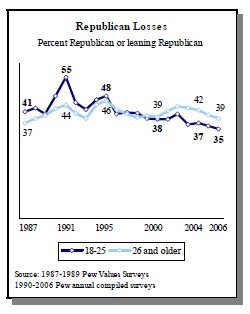
Really interesting stuff out of Pew regarding "Generation Next" - the 18-25 generation. Highly recommended, as reaching this generation (from a political, social and entertainment point of view) could be highly different than other generations.

First, note the difference between this generation's outlook on "friends" and entertainers vs. politicians and spiritual


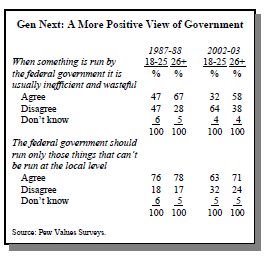
It's ironic, when you consider that this generation actually has a much greater appreciation for government than one's past:


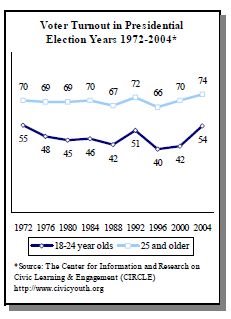
One of my favorite stats - look at the difference in turnout in 2004. That's a 25% jump from 2000. Also, note the similarity between 1972 and 2004 - apparently the Vietnam and Iraq wars are becoming more and more the same animal. (I consider 1992 an outlier, as it involved both Ross Perot, an interesting indie candidate, and Clinton, the first candidate to use MTV as a platform).


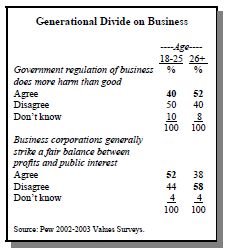
They also seem to hold what at first appear conflicting views on business and government regulation, but in fact aren't...rather that both are important in a healthy and functioning society and economy.


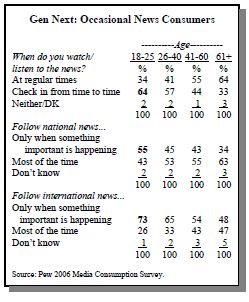
I actually disagree with Pew's interpretation that they consume news equally as with other generations. I view it as there are more passionate, motivated younger individuals and less people who aren't all that bothered to pay attention.


Couple other things I found fascinating - check out how they connect with environmental issues, and how unconcerned they are with race-based issues:


Finally, my favorite stat. Look at how much the younger generation (18-25) has changed from 1991 to present, while the age range 26+ has basically stayed the same. In 10-15 years, this could be seismic.

Starting to get scared

First Arnold, now this? Isn't this supposed to be one of the "signs" along with rivers running red with blood, etc?

...Until yesterday, it appeared that no news release on annual climate trends out of the National Oceanic and Atmospheric Administration under the Bush White House had said unequivocally that a buildup of greenhouse gases was helping warm the climate.“

A contributing factor to the unusually warm temperatures throughout 2006 also is the long-term warming trend, which has been linked to increases in greenhouse gases,” the release said, emphasizing that the relative contributions of El Niño and the human influence were not known.
Not sure about this one though....
James L. Connaughton, chairman of the White House Council on Environmental Quality, said the release reflected longstanding views within the administration.

“It’s helpful for them to describe what is a question in many people’s minds — what is the human factor, what is the El Niño factor,” Mr. Connaughton said of the NOAA release. “From our perspective, what was in the press release was a direct reflection of what the president and folks in his administration have been saying for some time.”

Emissions Cuts Order from America's Favorite Liberal

America's favorite foreign governor, Ahnold, with his latest endeavor - ordering cuts in California emissions.

Gov. Arnold Schwarzenegger said Tuesday that he would ask regulators to require the state’s petroleum refiners and gasoline sellers to cut by 10 percent the emissions of heat-trapping gases associated with the production and use of their products.

The order for cuts, which the governor wants completed by 2020, follows California’s trademark pattern of hitching its environmental aspirations to its market muscle. It also represents one of the first examples of a state or a national government regulating the fuel in its passenger vehicles as part of a strategy to reduce both emissions that contribute to climate change and dependence on foreign oil.

The executive order asks state air regulators to take up the governor’s challenge. The California Air Resources Board will be responsible for drawing the blueprints to carry out the order, with the help of advisers from the University of California, Berkeley.
There's actually a lot here for the alternative fuels sector.
The 10 percent cut in emissions would be accomplished, experts said, largely through the use of alternative fuels, like ethanol and other gasoline blends, which would be provided by the refineries and other producers.

Environmentalists expected the order to turbocharge the market demand for corn-based ethanol and biodiesel fuels, and for natural gas, and to jump-start the introduction of experimental fuels like cellulosic ethanol, which is made from plant waste or nonfood crops like switch grass or wood chips.

The contemporary environmental movement links clear air goals to potential profits, and Mr. Schwarzenegger’s order, with input and support from lobbyists from Environmental Defense, the Natural Resources Defense Council and the Hewlett Foundation, mirrors that approach. The companies or industries that stand to benefit financially from his plan include producers of corn-based ethanol, biodiesel and other, more experimental forms of renewable fuels.
One especially interesting aspect involves the understanding of "cradle-to-the-grave" concepts, so typically absent from non-sustainable manufacturing processes:
The plan....is unusual in its focus on the so-called cradle-to-grave emissions associated with each fuel. In the case of ethanol, this can mean carbon emissions generated in the production of fertilizer, in the planting and harvesting of corn, in distilling the fuel and, finally, in transporting it to the distributor and burning it in a car. Thus, two otherwise identical gallons of ethanol could have different greenhouse-gas ratings, if one were refined using carbon-intensive coal-fired electricity, while the other was refined using relatively carbon-light electricity from natural gas.

Monday, January 08, 2007

GM's Electric Car - Version 2.0

As I wait for this flick from Netflix, news comes of General Motor's latest attempt at being a responsible automaker (and by "responsible", I mean trying to match consumer demand with products that can be profitable and brand-enhancing).

General Motors Chairman G. Richard Wagoner Jr. on Sunday unveiled an innovative prototype, the Chevrolet Volt -- a plug-in vehicle that derives its power primarily from electricity rather than gasoline -- as the world's automakers take on global warming and U.S. dependence on foreign oil.

Wagoner's announcement underscores the depth of GM's previous miscalculation on alternative vehicles and the degree to which the U.S. automotive landscape is changing. In 1990, GM introduced the concept of an all-electric car, the EV1. The vehicle made it to U.S. consumers but didn't survive through the decade.

GM hasn't given a date when consumers can buy the Volt because the advanced lithium-ion batteries needed to power the vehicle -- similar to technology used in cellphones -- are still years from widespread use in automobiles.
Are they even trying at this stage? To me, it sounds as though that whole "strategy" thing is pretty absent from the process. The scent of desperation hangs heavy in the air. Just sayin'... as these batteries might have a wee bit of importance to the ultimate success of this venture. But oh, don't worry, the CEO's on it.
Though the battery technology is still early in development, GM officials say they are pushing ahead. "We are taking a calculated gamble on this," said Robert A. Lutz, GM's vice chairman of global product development. "We are making the bet that the batteries will be available."
Ladies and gentlemen. We're not America's largest potentially bankrupt company for nuthin.

Japanese Energy Efficiency

Really like this story on Japan's extremely energy conscious ways.

Japan is the most energy-efficient developed country on earth, according to most specialists, who say it is much better prepared than the United States to prosper in an era of higher global energy prices. And if there is any lesson that Japan can offer to Americans, they say, it is that there is no one fix-all solution to living with oil above $50 a barrel.

Rather, as Mr. Kimura shows, it is a combination of many things, from the most advanced technologies to the simplest frugality in everyday life — and an obsession with saving energy that keeps his family huddled in a single heated room during winter.
The notion that it takes both the individual and a collective social consciousness working together is very valuable. The article also mentions the Japanese government's tax on gasoline which pushes it to $5.40 a gallon, and where the subsequent tax revenues have gone.

Finally:
Higher energy prices have also created strong domestic demand in Japan for more conventional and new energy-saving products of all sorts. That has spurred the invention and development of things like low-energy washing machines and televisions and high-mileage cars and hybrid vehicles, experts say. Japanese factories also learned how to cut energy use and become among the most efficient in the world.

Companies like Mitsubishi Heavy Industries are now reaping the benefits in booming overseas sales of their highly efficient electric turbines, steel blast furnaces and other industrial machinery, particularly in the United States. The environment ministry forecasts that exports will help turn energy conservation into a $7.9 billion industry in Japan by 2020, about 10 times its size in 2000.
Is it any wonder that Toyota and Honda have taken the lead in developing hybrid technology?

Saturday, November 11, 2006

Tipping Point?

Interesting follow up in light my recent post below that partially discussed James Lovelock's prediction that the Earth is reaching a carbon tipping point of sorts much faster than previously anticipated.

From the Independent:

The growth in global emissions of carbon dioxide from fossil fuels over the past five years was four times greater than for the preceding 10 years, according to a study that exposes critical flaws in the attempts to avert damaging climate change.

Data on carbon dioxide emissions shows that the global growth rate was 3.2 per cent in the five years to 2005 compared with 0.8 per cent from 1990 to 1999, despite efforts to reduce carbon pollution through the Kyoto agreement.

Also - interesting follow-on to point number 6 in previous post.
Much of the increase is probably due to the expansion of the Chinese economy, which has relied heavily on burning coal and other fossil fuels for its energy.
And just in case you need historical context in order to not sleep tonight.
Based on current trends, carbon dioxide concentrations are likely to increase to 500ppm this century. The last time the planet experienced levels as high as 500ppm was about 20 or 40 million years ago, when sea levels were 100 metres higher than today.
I'm reminded of a line from a recent gawdawful Wall Street Journal op-ed. They had a slightly different perspective...minor, almost semantics really...
The second point is that the Stern report barely mentions the potential benefits from warming in the world's cold-weather regions. Al Gore and others warn about the damage from coastal flooding and changing weather patterns, among other horror scenarios. But the world is large and its climate diverse, and a longer growing season in Siberia or Canada is at least one possible benefit of warming.

So wait, it's not a hoax?

Barbara Boxer pledges a very different approach to global warming as chair of the US Senate's Environmental Committee.

Boxer's elevation to chairwoman of the Senate Environmental Public Works Committee comes as the Democrats return to power in the Senate. It also marks a dramatic shift in ideology for the panel.

The California Democrat is one of the Senate's most liberal members and replaces one of the most conservative senators, Republican James Inhofe of Oklahoma. Inhofe had blocked bills seeking to cut the greenhouse gases contributing to global warming, calling the issue ''the greatest hoax perpetrated on the American people.''

This is great news.
Boxer said she intends to introduce legislation to curb greenhouse gases, strengthen environmental laws regarding public health and hold oversight hearings on federal plans to clean up Superfund sites across the country.

On global warming, Boxer said she would model federal legislation after a California law signed this summer by Gov. Arnold Schwarzenegger. That law imposes the first statewide cap on greenhouse gases and seeks to cut California's emissions by 25 percent, dropping them to 1990 levels by 2020.

A top environmental aide at the White House signaled Thursday that the administration would work with Boxer.

On the last point, I remain in wait-and-see mode.

Friday, November 10, 2006

I remember you

Been a while, eh? Anything happened? Nah, I didn't think so...

That said...sigh...three months can go by so quickly. Anyways, I've got a backlog of things to post, although half of the links have probably been moved.

In any event, I wanted to draw attention to the recent NY Review of Books article, covering several recent books discussing global warming.

The books covered:
1. The Revenge of Gaia: Earth's Climate in Crisis and the Fate of Humanity (James Lovelock)
2. China Shifts Gears: Automakers, Oil, Pollution, and Development (Kelly Sims Gallagher)
3. Solar Revolution: The Economic Transformation of the Global Energy Industry (Travis Bradford)
4. WorldChanging:A User's Guide for the 21st Century (Alex Steffen)
5. Design Like You Give a Damn: Architectural Responses to Humanitarian Crises (edited by Architecture for Humanity)

Among the most interesting points to me:
1. Lovelock's tipping point relies on the same mechanisms as most other climate scientists, but as with most, his prediction of the results varies in both impact and time. Shorter Mr. Lovelock: we're screwed.
2. The Gaia hypothesis is alive and well
3. The science of climate behind climate change is moving faster than any literature can keep up. Apparently already An Inconvenient Truth is outdated.
4. Lovelock doesn't want wind power because it disturbs his beloved countryside.
5. Travis Bradford is an I-banker who believes solar will grow annually 20% to 30% for decades (similar growth rate in the computer chip industry). He discusses at length the success of Japan and Germany in increasing solar investment through government subsidies that are now no longer necessary.
6. "In retrospect, historians are likely to conclude that the biggest environmental failure of the Bush administration was not that it did nothing to reduce the use of fossil fuels in America, but that it did nothing to help or pressure China to transform its own economy at a time when such intervention might have been decisive."
7. Check out World Changing's website. Incredible resource for impacting our environment with simple technology at hand. Tremendous example of "the Wisdom of the Masses".
8. Where the hell is that carbon tax already?

Saturday, August 05, 2006

Not scary at all

Maybe more articles of this nature, and things would actually start to happen.

Even scarier is the other sight, about 20 meters down off the coast of Santa Barbara, Calif.: bubbles, millions of bubbles of methane -- 20 times more powerful as a greenhouse gas than carbon dioxide.

The methane is bubbling up naturally from some of the enormous natural undersea reservoirs of the gas mostly locked into the frozen mud under the sea floor.

...

Scientists have just released video showing how, for the first time, they have been able to measure these natural up-wellings to tell whether, if large amounts of this methane ever thawed out from its deep sea beds, it would reach the atmosphere, rather than being absorbed in the water, and thus make the earth even hotter.

The findings of oceanographer Ira Leifer et al, published in a strictly peer-reviewed scientific journal, are that it would do just that.

In other words, all that undersea methane is a potential "positive feedback" of catastrophic proportions.

If warming currents, such as those already detected by scientists at depth, begin to thaw these methane beds, it will make the atmosphere, and consequently the sea currents, even warmer, and melt out more methane.

A number of scientists tell me that would take the Earth up into temperatures humankind has never experienced -- and probably could not survive.

As far as I can tell, this ran on ABC News. Now, at this stage in the game, maybe 18 Americans still get their news from ABC. But if we can convert just two of those, and they convert two, and those four each convert two...by 2080 we'll be good to go.

Thursday, August 03, 2006

I guess I like this...biofuels initiative

Anything involving this Administration I'm dubious about, but this doesn't seem all that...harmful

The federal government will spend $250 million to help create two research centers that will focus on finding more efficient ways to produce cellulosic ethanol and other biofuels, Energy Secretary Samuel W. Bodman announced Wednesday during a visit to Illinois.

[snip]

The two winning organizations each will receive $25 million per year for five years, beginning in the 2008 federal fiscal year, to develop and operate the research centers, which are expected to be fully operational by 2009, said Raymond L. Orbach, undersecretary of energy for science.

While corn and soybeans are widely used to produce ethanol and biodiesel for fuel, the new research centers will be charged with looking to efficiently break down other natural materials, or biomass — such as grasses, crop residue and animal byproducts — to help make fuel.

Although of course, as with everything, there's self interest involved. And who is this farmer? Where does an AP reporter happen upon a farmer? Are they listed in the yellow pages under "Farming, Personal"? Sniff...I smell a planted individual from a biased third-party:

Farm states such as Illinois should benefit from the research because it could lead to new cash crops and markets for them, said Mazon-area farmer Jay Fillman.

"When you do that basic research, that can really open up new opportunities and probably make it a more sustainable, economic driven industry, instead of being driven by the subsidies as it is right now," he said.

Uh-huh. Whatever you say...Jay...if that's really your name...

Wednesday, August 02, 2006

But wait, there's more...

This is pretty cool:

Twenty-two of the world's largest cities announced Tuesday they will work together to limit their contributions to global warming in an effort led by former President Bill Clinton.

The Clinton Climate Initiative -- which will create an international consortium to bargain for cheaper energy-efficient products and share ideas on cutting greenhouse gas pollution -- includes Chicago, Los Angeles, Philadelphia and New York as well as Cairo, Egypt; Delhi, India; London and Mexico City. While the group is not setting specific targets for reducing emissions, Clinton said, he is confident the effort will both cut pollution and create jobs in the cities that contribute most to higher temperatures.

One fascinating little tidbit points to an interesting potential strategy. Focus efforts exclusively on the worst emitters (say top 100) for the time being, to reduce potential negative economic consequences, developing world concerns, etc.
The 40 cities he is targeting account for roughly 15 to 20 percent of the world's emissions...

...The Clinton Foundation will focus on providing technical assistance and bargaining power to the participating cities, all with area populations of 3 million or more, employing the same model it has used to lower the price of AIDS medicine for poorer countries.

Cities Respond to Global Warming Challenge

Yeah yeah. I've been busy.

In any event, some interesting GW news. Into the vacuum of leadership created by the absence of Bush Administration interest in what even Ron Burgundy would refer to as "a pretty big deal", steps others:

Tony Blair yesterday sidestepped the Bush administration's refusal to act on climate change by signing what was hailed as a ground-breaking agreement with California, the world's 12th largest carbon emitter, to fight global warming.

Downing Street made no attempt to disguise the fact that the deal is designed to get round Republican objections to states imposing mechanisms to cut carbon emissions. With other US states also interested or involved in carbon trading markets, the path is being opened to bring US business into international efforts to fight climate change, even though international progress has been stymied by the Bush administration's refusal to sign up to binding targets in the Kyoto protocol.

And while the LA Times editorial section may be mildly dubious, it still praises the efforts, and describes the importance of public/private partnerships:
FOR ALL THE FANFARE that preceded it, the agreement on global warming signed Monday by British Prime Minister Tony Blair and Gov. Arnold Schwarzenegger is more a promise than a plan. The nation and the nation-state, the two leaders agreed, will collaborate on new, clean-fuel technologies and research the costs and benefits of mandatory emissions trading programs such as those recently put in place in Britain and the rest of Europe.

[snip]
In fact, business — the constituency so many politicians fear to ruffle by proposing energy regulations — has shown more leadership than many governments on climate change. Business leaders recognize that it is more than simply an environmental issue. It's an energy issue. It's an economic issue. It's a national security issue.

They also recognize the costs of doing nothing. Not only the costs of drought and hurricanes, which we're already paying, but the opportunity cost. They see not just a moral imperative but a market for cleaner energy. The United States, which has always risen to scientific and technological challenges, is in danger of sitting this one out.

But even business leaders acknowledge that they cannot solve this alone. As BP Chief Executive John Browne, who hosted the Blair-Schwarzenegger meeting at BP's Long Beach shipping terminal, said at a meeting Tuesday with The Times' editorial board, the role of governments can't be underestimated even in seeking a market-based solution. "The way government creates regulations determines markets," he said. "And markets determine behavior."
Ahhh leadership. Smells of rich mahogany...

Saturday, July 15, 2006

Green Building Competition (oh and Mr. Jolie's involved)

Yeah, the title's not the point (although a sad statement about our current administration). Rather it's the concept underlying. Who would've thought our generation's Rat Pack (Clooney, Pitt, etc.) would be so socially aware. Also points to the value of attaching a celebrity to any project you do. Just about guarantees publicity:

...Pitt was in New Orleans to give an update on a project he's promoting — a competition to choose ecologically sound designs for rebuilding neighborhoods.

"There's a big opportunity here," he said, to rebuild the city using energy-efficient building materials and appliances that would improve quality of life, particularly in low-income communities.

Global Green USA, a national environmental organization, is working with Pitt on the design project. Pitt heads a jury of architects, city residents and others who decided Friday on the top five environmentally friendly designs out of more than 100 entries. The designs were submitted by individuals and architect firms.

More info can be found here. And kudos to Mr. Pitt for stepping up and attaching his name to this type of project.

Friday, July 14, 2006

Grab the Sunscreen/Lead Suit

Awesome.

The average temperature for the continental United States from January through June 2006 was the warmest first half of any year since records began in 1895, scientists announced today. The average January-June temperature for the contiguous United States (based on preliminary data) was 51.8 degrees F (11.0 degrees C), or 3.4 degrees F (1.8 degrees C) above the 20th century (1901-2000) average.

Five states (Texas, Oklahoma, Kansas, Nebraska and Missouri) experienced record warmth for the period. No state was near or cooler than average. The report comes from NOAA' National Climatic Data Center in Asheville, N.C.


Of course, of course, you can't draw inferences from six months of data. Luckily, we've got 15-20 years EASY before we have to start worrying. So that should give us plenty of time for more studies.

A scientific study commissioned by the Bush administration concluded yesterday [May 3, 2006] that the lower atmosphere was indeed growing warmer and that there was "clear evidence of human influences on the climate system.

---

But White House officials noted that this was just the first of 21 assessments planned by the federal Climate Change Science Program, which was created by the administration in 2002 to address what it called unresolved questions. The officials said that while the new finding was important, the administration's policy remained focused on studying the remaining questions and using voluntary means to slow the growth in emissions of heat-trapping gases like carbon dioxide.

We're here...we're...green...we're not going anywhere?

Uh-oh. Looks like I need to make a little room on the bandwagon:

Eco-consciousness appears to be hitting the mainstream. For years, it was only the truly committed, the painfully hip and the guiltily ashamed who were willing to stand up in public and say they were willing to do something for the environment.

Now environmentalism has gone way beyond the sandal-ista crowd. We just may be entering a time when everyone from average individuals to giant corporations to politicians of all ideologies agree that the evidence of environmental degradation is so overwhelming that it's finally time to act
And for that, you can thank the loosening of the strangehold that Baby Boomers have had on society for the past thirty years, and start appreciating the younger generations. Seriously, if there was a more selfish generation, I'd like to see it. Environmental destruction? Check. Massive deficits? Check. Elimination of increases in the minimum wage? Check. Elimination of certain taxes for the wealthy? Check. Look, don't get mad at me for pointing it out...who keeps voting the Republicans in? Where's the base? It ain't amongst the kids (or anyone under 35). And shockingly (not), now that all the Baby Boomers have retired and want to ensure their entitlements stick around, they start voting Democrat. Its one long selfish decision after another. Sigh. Rant over. Love you mom.

How to be carbon neutral, though? It turns out it's as easy as writing a check. Various organizations will take your money and then go invest in planting trees, developing wind farms and other activities that "offset" the carbon dioxide you're responsible for creating.

It sounds a little nutty, and there is disagreement as to how well such a system works. But if you think about it, it's kind of a cool idea. Not all of us are cut out for driving Priuses, carrying burlap sacks to the market or putting on a sweater in our cold living rooms.

If not, fine. Paying someone else to do the things you're not willing to may be incredibly bourgeois, but it is in fact good for the environment.
I could be snotty, but anything is an improvement at this stage. And should carbon neutral living ever really sweep the mainstream, there may actually be a chance of change.

Wrapping up with some cool ideas (or maybe just ideas) (and now that I think about it, I may need to change some of the slang I use in writing on this subject):

Panelists at a Brainstorm session on global warming had a few of their own.

Lawrence Bender, producer of Al Gore's film, "An Inconvenient Truth," told of the big corporation that is getting its truckers to turn off the air conditioning when they are idling.

Carol Browner, former administrator of the EPA, advocates national legislation to reduce carbon emissions that would replace a patchwork of local regulations that dog businesses around the country.

John Hickenlooper, the mayor of Denver, points out that tiny efforts, like educating people to keep the tires on their cars filled, will contribute to better gas mileage and lower emissions.

Fred Krupp, chief of Environmental Defense, wants to see a federal carbon cap along with a system that would allow companies to trade credits toward achieving that cap. (Sens. John McCain and Joe Lieberman have proposed such legislation that so far hasn't gone anywhere.)

This is an issue that is anything but neat and tidy; even people who call themselves environmentalists aren't in lockstep. Venture capitalist Vinod Khosla, for example, is a big proponent of forward-thinking ethanol technology. Lester Brown, a noted environmentalist, would far prefer to see the country focusing on wind power. They clashed in Aspen.

Thursday, July 06, 2006

Short-termism and sustainability - an investor's perspective

Found a wonderful little speech from Al Gore (what can I say, I'm smitten) that he gave at the Institutional Investor Summit on Climate Risk in May 2005.

He focuses on two themes - the concept of short-termism among investors, and how to value sustainability within a company. Among the highlights:

The average mutual fund turns over its entire portfolio every ten months. I can make a case to you that that is functionally insane. Why? First of all because a long-term investor is supposedly investing in the value of the company. Sixty to 70 percent of the value of the average company builds up over a period of years.

The McKinsey Quarterly came out with a report that found this:...more than 80 percent of executives, said that they would cut expenditures on R&D and marketing to ensure that they hit quarterly earnings targets, even if they believed that the cuts were destroying value over the long-term. Eighty percent.

The practice of looking solely at the financial reports means looking only at a narrow slice of that spectrum of information. Yet the information that lies in a company’s environmental practice, employee practices and the other non-financial factors can also be very important.

Abraham Maslow, the great psychologist, once said, “if the only tool you have is a hammer, every problem begins to look like a nail.” And in the same way, if the only tool that we use to analyze what's valuable is a price tag, then those things that don't have a price tag can begin to look like they have no value.

You know, there are a lot of companies out there that have been whistling past the graveyard of big environmental risks. And, in fact, 10 of the largest 15 bankruptcies have occurred since 2001. That's partly an accounting artifact of the rising value of conglomerates, but it's also a result of some very large risks that go past the quarterly and the annual time horizon not being adequately analyzed and integrated into the assessment of value.

We're all here filling a kind of a policy vacuum. But...I believe -- we are here at an extraordinarily hopeful moment...I know there are tipping points in the political system also. Globally and nationally. And when GE moved and when Cinergy and Duke moved, that moved us closer to that tipping point.

When the leaders in the business sector begin to make their moves, before the policy vacuum can really be filled, there's one big, final step, and that is, for investors led by those of you who are here who have a requirement to take a long-term view decide to take the businesslike, commonsense, difficult but necessary steps to shift the perspective and integrate the data and start acting in ways that are fully faithful to your fiduciary responsibilities.

Pregnancy linked to global warming

Not trying to be a dick. Just saying, seeing as everything else appears to be...

The increase in the number of large western wildfires in recent years may be a result of global warming, researchers say.

I imagine as the pace of change in our atmosphere speeds up we'll see more and more scenarios of this type - changes in feeding patterns, vegetation, crop diseases, coral reefs, migration routes, etc.
The researchers used the files of the U.S. Forest Service and National Park Service to analyze 1,166 fires of more than about 1,000 acres. Their findings are published Thursday in the online edition of the journal Science.

Beginning about 1987, there was a change from infrequent fires averaging about one week in duration to more frequent ones that often burned five weeks or more, they reported. The length of the wildfire season was extended by 78 days.

The researchers said the changes appear to be linked to annual spring and summer temperatures, with many more wildfires burning in hotter years than in cooler years.

They also found a connection between early arrivals of the spring snowmelt in the mountainous regions and the incidence of large forest fires. An earlier snowmelt, they said, can lead to an earlier and longer dry season, which provides greater opportunities for large fires.

Oh well. According to those with their head in the sands, global warming will lead to increased rainfall, so I suppose this will all be a "wash"...(euw)

FYI - The research was supported by the National Oceanic and Atmospheric Administration, the Forest Service and the California Energy Commission.